
A Glimpse Through the Cosmic Dust
Imagine trying to understand a city's power grid by only looking at its nighttime glow. For decades, that’s how astronomers have studied many galaxies. The most active and crucial regions—the bustling hearts where stars are born—are often shrouded in thick
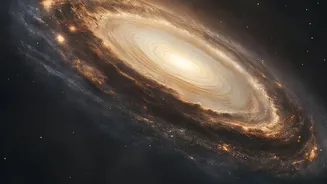
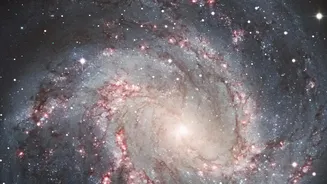
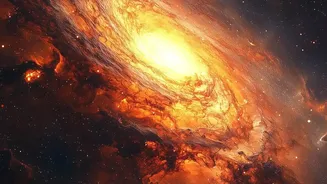
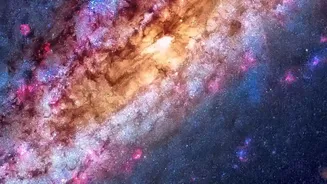
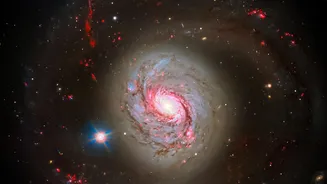
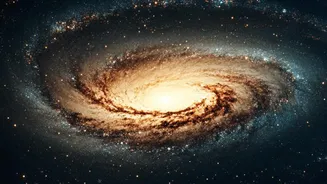
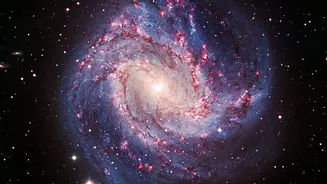
clouds of cosmic dust, blocking most visible light. This has left a frustrating gap in our knowledge. Recent observations, however, have finally pierced this veil. Using the powerful infrared capabilities of the James Webb Space Telescope (JWST), astronomers are getting their first clear view of the complex structures at the centres of spiral galaxies. These new images reveal intricate networks of gas, dust, and densely packed clusters of young stars that were previously invisible.
The Telescope That Sees the Invisible
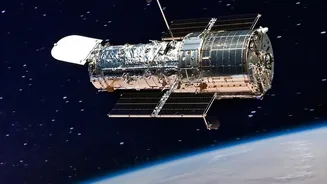
The breakthrough is thanks to JWST's ability to detect infrared light. This light has a longer wavelength than visible light, allowing it to pass through dense clouds of cosmic dust that would otherwise obscure the view. Think of it like the difference between a flashlight and an X-ray; one is stopped by a wall, while the other passes through. JWST's Mid-Infrared Instrument (MIRI) is particularly adept at this, capturing the faint heat glow emitted by the dust itself. This allows scientists not just to see past the dust, but to map its distribution and temperature. By doing so, they can trace the fuel for future star formation and see the architecture of the galaxy's core with stunning clarity. This technology effectively gives astronomers a new set of eyes to study the universe.
Rewriting the Galactic Playbook
These new observations are doing more than just providing pretty pictures; they are forcing scientists to rethink fundamental theories of galaxy evolution. For instance, recent studies have uncovered surprisingly mature and complex galaxies in the very early universe, systems that appear far more developed than models predicted for that cosmic era. This suggests that the first chapters of galaxy formation may have been much faster and more dramatic than previously thought. In other cases, observations have revealed why some galaxies suddenly stop forming stars. Detailed images show subtle signs of past violence, suggesting these “quenched” galaxies were likely involved in dramatic mergers with other galaxies that shut down their stellar nurseries. Seeing these hidden details allows for a form of galactic archaeology, where each newly visible star cluster helps reconstruct the timeline of cosmic events.
The Engines of Creation and Destruction
At the heart of many of these findings is the interplay between star formation and the supermassive black holes that lurk at the centre of most large galaxies. The newly revealed structures, such as stellar bars, are now understood to be cosmic conveyor belts, funnelling gas and dust toward the galactic centre. This material can either fuel a burst of new star formation or feed the central black hole, triggering immense outpourings of energy that can, in turn, influence the entire galaxy. One recent study showed a supermassive black hole stirring and heating a surrounding pot of cold gas, effectively preventing it from collapsing to form new stars. Understanding this delicate balance between creation and destruction is key to solving the mystery of how galaxies build themselves over billions of years.