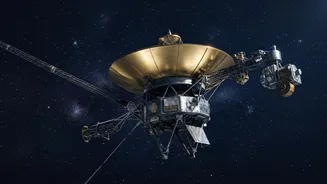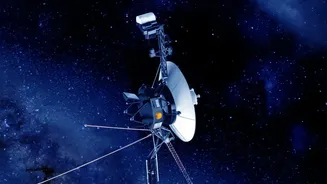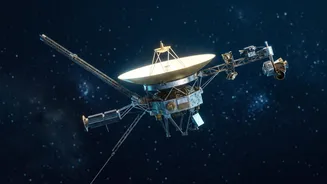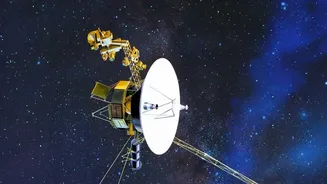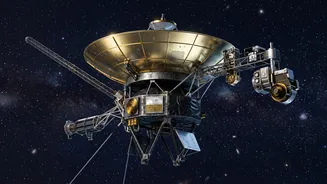





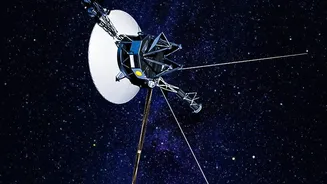
After nearly 50 years adrift in the cosmos, Voyager 1 gave its creators a scare. Now, following a brilliant long-distance repair, humanity’s farthest envoy is not only speaking clearly again but is also fast approaching two historic milestones.
A Frightening Silence from the Void
In late
2023, the steady stream of data from Voyager 1, a vessel more than 24 billion kilometres away, turned to gibberish. The probe, a relic of 1970s engineering, was sending back a useless, repeating pattern of code. The fault was traced to its Flight Data System (FDS), the spacecraft's brain responsible for packaging science and engineering data for the long journey home. For five months, the mission team at NASA's Jet Propulsion Laboratory (JPL) faced a daunting challenge: how to troubleshoot a computer chip that is almost a full light-day away. The 45-hour round-trip for any communication meant each attempt to diagnose the problem required nearly two days of waiting for a response.
An Ingenious Long-Distance Repair
The JPL team determined that a single memory chip in the FDS had failed. With no way to physically repair it, they devised a clever workaround. Since the faulty chip couldn't store the full code, engineers decided to surgically slice the affected code into smaller sections. They then tucked these segments into different, still-functioning locations within the FDS memory. It was a delicate, unprecedented hack performed on a 46-year-old computer across an unimaginable distance. The team meticulously crafted the code to ensure all segments would work together as a cohesive whole. The first part of this fix was sent in April 2024, and after an anxious wait, Earth received a coherent signal: the patient was stable.
More Recent Drama and Recovery
More recently, in October 2026, the spacecraft gave its team another jolt. For 48 hours, between October 18 and 20, the probe went completely silent. Fortunately, the signal reappeared on its own before engineers had to send troubleshooting commands. Investigations suggest the craft's autonomous fault protection system kicked in, swapping to a backup set of thrusters after detecting an issue. This was followed by a power-saving maneuver nicknamed the 'Big Bang', where several heaters were swapped for lower-power alternatives to conserve precious energy from the decaying plutonium power source. These successful recoveries showcase the resilience of both the machine and its human operators.
Approaching a Half Century of Exploration
With communications restored, Voyager 1 continues its journey toward a remarkable anniversary. Launched on September 5, 1977, the spacecraft will celebrate 50 years of operation in September 2027. Originally designed for a five year mission to study Jupiter and Saturn, its longevity is a testament to its robust design. Having outlived its primary mission by decades, it has become humanity’s longest running and most distant emissary, pushing the boundaries of what was thought possible. Its plutonium power source loses about four watts of power each year, forcing engineers to make difficult choices about which instruments to shut down to prolong the mission's life.
The One Light Day Frontier
Even before its 50th birthday, Voyager 1 will cross a mind bending threshold. On November 18, 2026, it is projected to become the first human made object to be one light day away from Earth. A light day is the distance light travels in $24$ hours, an immense span of approximately $26$ billion kilometres. At that point, the radio signals used to command the probe will take a full day to reach it, and another day for its response to be heard back on Earth. While just a number, this milestone puts the scale of Voyager’s journey into a new perspective, highlighting the vastness of the interstellar medium it now sails through.