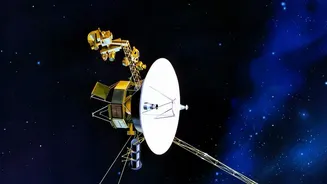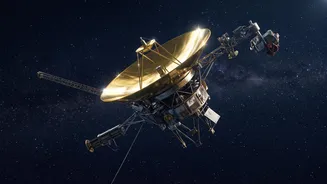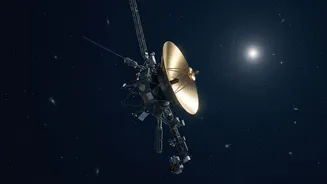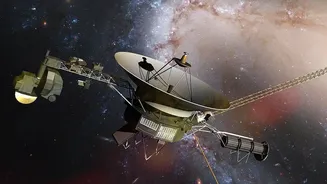



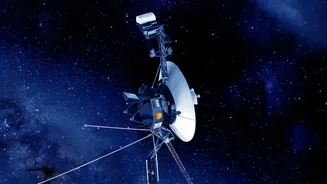
Launched when disco was king, NASA's Voyager 1 spacecraft is still pushing the boundaries of exploration. Now, nearly 50 years into its lonely journey, it is about to cross a threshold that puts its incredible distance into perspective.
What Exactly is a Light-Day?
A light-day isn't
a measure of time, but of immense distance. It is how far a particle of light travels in a vacuum in 24 hours. That distance is a staggering 25.9 billion kilometres, or about 16.1 billion miles. To put that into perspective, it takes sunlight just over eight minutes to reach Earth, which is one 'astronomical unit' (AU) away. A light-day is equivalent to about 173 AUs. On November 18, 2026, Voyager 1 will become the first human-made object to reach this distance from our planet. At that moment, a radio signal sent from NASA's Deep Space Network will take a full 24 hours to reach the probe, and another 24 hours for a response to travel back. This two-day communication lag underscores the mind-boggling scale of Voyager's achievement.
A Grand Tour and Beyond
Voyager 1's journey began on September 5, 1977, launched 16 days after its twin, Voyager 2. Its original mission was a 'Grand Tour' of the outer planets. It flew by Jupiter in 1979 and Saturn in 1980, using their gravity to slingshot itself to incredible speeds. The probe made groundbreaking discoveries, revealing volcanic activity on Jupiter's moon Io and providing detailed images of Saturn's complex ring system. After its planetary encounters, its mission was extended. In 1998, it surpassed Pioneer 10 to become the most distant human-made object from Earth. Then, on August 25, 2012, it achieved its most historic feat: crossing the heliopause, the boundary where the Sun's solar wind gives way to the interstellar medium, officially entering the space between stars.
Whispers from the Void
Keeping a nearly 50-year-old spacecraft operational is a monumental challenge for NASA engineers. Voyager 1 operates on primitive technology by today's standards, with just 68 kilobytes of computer memory. Its power comes from a decaying plutonium source that loses about four watts of power per year. To conserve energy, engineers have been systematically shutting down instruments and heaters, a delicate process considering the frigid temperatures of deep space. In late 2023, the probe began sending back garbled data, a problem that took five months to diagnose and fix by remotely rewriting software on a failed memory chip 24 billion kilometres away. As of late 2026, only two of its original ten science instruments remain active, listening to the hum of interstellar plasma.
Why This Milestone Matters
Reaching one light-day isn't just a number; it is a profound testament to human curiosity and engineering. The Voyager mission has transformed our understanding of the solar system and is now providing the first direct measurements of interstellar space. These probes are our silent ambassadors, carrying a 'Golden Record'—a gold-plated disc containing sounds, images, and greetings from Earth in case they are ever found by another civilization. While its signal will eventually become too faint for us to detect, sometime in the 2030s, Voyager 1 will continue its journey in silence. It will take about 300 years to reach the inner edge of the Oort Cloud, a vast shell of icy objects at the far frontier of our solar system. In about 40,000 years, it will pass near a star named Gliese 445.