






Start with the Ingredients List
Before you even look at the numbers, check the ingredients list. Regulated by the Food Safety and Standards Authority of India (FSSAI), this list is your most honest guide to what's inside a product. Ingredients are listed in descending order by weight.
This means the first two or three ingredients make up the bulk of what you're eating. If you see sugar, refined flour (maida), or palm oil at the top of the list for a product marketed as 'healthy' or 'wholegrain', it might be time to reconsider. Also, be aware that sugar can be disguised under many names, such as corn syrup, fructose, or dextrose.
The 'Per 100g' Column is Your Best Friend
Most labels show two columns: 'per serving' and 'per 100g' (or 100ml). Always focus on the 'per 100g' column. Why? Because the manufacturer decides the 'serving size,' and it's often unrealistically small to make the numbers look better. A small packet of chips might declare a serving size of 30g, but most people consume the entire 100g packet in one sitting. The 'per 100g' value is a standardised measure, allowing you to make fair and accurate comparisons between different products. It’s the only way to know if one brand of biscuits is truly lower in sugar than another.
Decoding Fats, Sugar, and Salt
This is the crucial trio for managing long-term health. On the nutrition panel, look for 'Total Fat' and its breakdown into 'Saturated Fat' and 'Trans Fat'. While some fat is essential, high levels of saturated and trans fats are linked to health issues. Under current FSSAI rules, products must contain less than 2% industrial trans fats. For sugar, the label may show 'Total Sugar' and 'Added Sugar'. 'Added Sugar' is the number to watch, as it represents sugars that are not naturally present in the ingredients. For salt, look at 'Sodium'. To maintain healthy blood pressure, adults should aim for less than 2000mg of sodium (about one teaspoon of salt) per day. A product with over 600mg of sodium per 100g is considered high.
What is % RDA?
The '% RDA' or '% Recommended Dietary Allowance' tells you what percentage of your daily nutrient needs one serving of the product fulfils. This calculation is typically based on a standard 2000-calorie diet for an average adult, as defined by Indian dietary standards. For example, if a serving provides 20% of your RDA for saturated fat, that single serving is using up a fifth of your daily limit. It’s a helpful tool to put the numbers into the context of your entire day's food intake, but remember it’s a general guide and individual needs can vary.
Look for the Good Stuff: Fibre and Protein
Nutrition labels aren't just about avoiding the bad; they're also about finding the good. Higher amounts of dietary fibre and protein are generally positive signs. Fibre is crucial for digestive health, while protein helps with satiety, keeping you feeling full for longer. When comparing products like breakfast cereals, breads, or snacks, a quick glance at these values in the 'per 100g' column can help you choose a more nutritious and filling option that provides sustained energy rather than a quick sugar rush.
The Future: Front-of-Pack Warning Labels
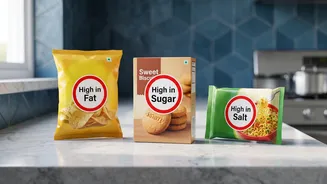
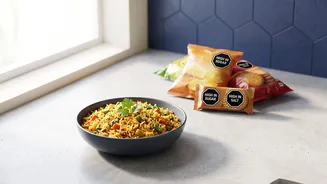
Change is on the horizon. After a Supreme Court push in September 2026, FSSAI is moving towards a mandatory Front-of-Pack Labelling (FOPL) system. This will replace an earlier proposal for a star-rating system. The new plan involves placing a prominent red hexagon on the front of packages for foods that are high in salt, added sugar, or added fat. The warning will be triggered if a product exceeds the threshold for even one of these nutrients. While the exact timeline is still being finalised by the courts and FSSAI, this move will make it much easier for shoppers to identify less healthy products at a single glance, without needing to turn the pack over and analyse the fine print.