






What Are Smart Prompt Templates?
Forget asking an AI to simply “explain a topic.” A smart prompt is a structured instruction that tells an AI not just what you want, but how you want it. It includes four key elements: a role, a task, specific constraints, and a desired format. Think
of it as the difference between asking a friend to “tell me about history” versus asking them to “act as a history professor and give me a five-point summary of the main causes of World War I, formatted as a bulleted list.” A template is a reusable version of this structure that you can adapt for any topic, turning the AI from a vague search engine into a personalized tutor.
Template 1: The Concept Mapper
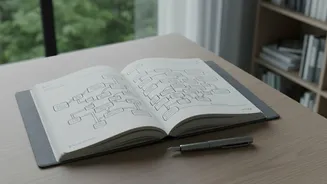
The first step to learning any complex subject is understanding its structure. A concept map provides a visual hierarchy of ideas, from the core concept down to the details. You can use a prompt template to have an AI build this for you. For example: “Act as an expert educator. Your task is to create a hierarchical concept map of [Your Complex Topic]. Start with the central theme and branch out into major sub-topics and key supporting details. Present this as a nested bulleted list.” You can then take this structured text and use it to sketch out a visual map or as a study checklist. This method helps you see the forest before you get lost in the trees.
Template 2: The Analogy Generator
Some concepts are difficult because they are abstract. An analogy connects a new, complex idea to a familiar one, making it easier to grasp. This is where AI can be incredibly creative. Use a template like this: “Act as a creative science communicator. Your task is to explain [Difficult Abstract Concept] to a 12-year-old. Use three simple, everyday analogies to illustrate the core idea. For each analogy, briefly explain how it connects back to the concept.” This forces the AI to simplify without losing the essence of the topic, giving you memorable mental hooks.
Template 3: The Socratic Tutor
Passive reading leads to poor retention. To truly learn, you need to engage with the material actively. You can program an AI to act as a Socratic tutor, questioning you to deepen your understanding. Try this prompt: “Act as a Socratic tutor. My goal is to understand [Your Study Topic]. Do not give me direct answers. Instead, ask me a series of probing questions that force me to think critically about the material, identify gaps in my knowledge, and connect different concepts. Start with one foundational question.” This turns your study session into an interactive dialogue, promoting genuine comprehension.
Studying Safely and Ethically with AI
Using AI as a study partner comes with critical safety rules. First and foremost, never trust, always verify. AI models can “hallucinate,” meaning they can invent facts, sources, and details with complete confidence. Always cross-reference important information with reliable academic sources. Second, protect your privacy. Never input personal or sensitive information into an AI chatbot, as these conversations can be stored and used for training. Finally, understand academic integrity. Using AI to brainstorm ideas or explain concepts is a powerful learning strategy. However, submitting AI-generated text as your own work is plagiarism. The goal is to use AI to support your thinking, not replace it.