

A Star Is Born... Or Is It?
On October 9, 1604, observers in Italy first noted a startlingly bright point of light in the constellation Ophiuchus, the Serpent-Bearer. Within days, it was seen across Europe and as far away as China and Korea. At its brightest, it outshone every star and planet
in the night sky, and was even visible in broad daylight for over three weeks. To the people of the 17th century, this was a profound and unsettling event. The prevailing view, inherited from the ancient Greek philosopher Aristotle, was that the heavens beyond the Moon were perfect and unchanging. A 'stella nova', or new star, was a direct contradiction to this millennia-old belief. It sparked debate, wonder, and fear across the world.
Enter Johannes Kepler
While he was not the first to see the new star, German astronomer Johannes Kepler became its most famous and meticulous observer. Working as the Imperial Mathematician in Prague, Kepler began his systematic study on October 17, tracking the star's position and brightness for over a year until it faded from view. He conducted all of his observations with the naked eye, as the telescope had not yet been turned toward the heavens. In 1606, he published his findings in a book titled 'De Stella Nova in Pede Serpentarii' ('On the New Star in the Foot of the Serpent-Bearer'). This work was not just a record of measurements; it was a foundational text of the emerging Scientific Revolution.
What Is a Supernova?
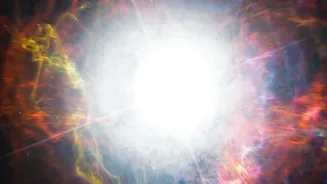
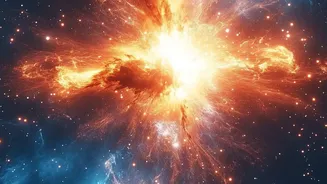
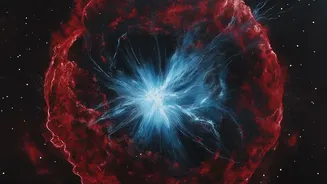
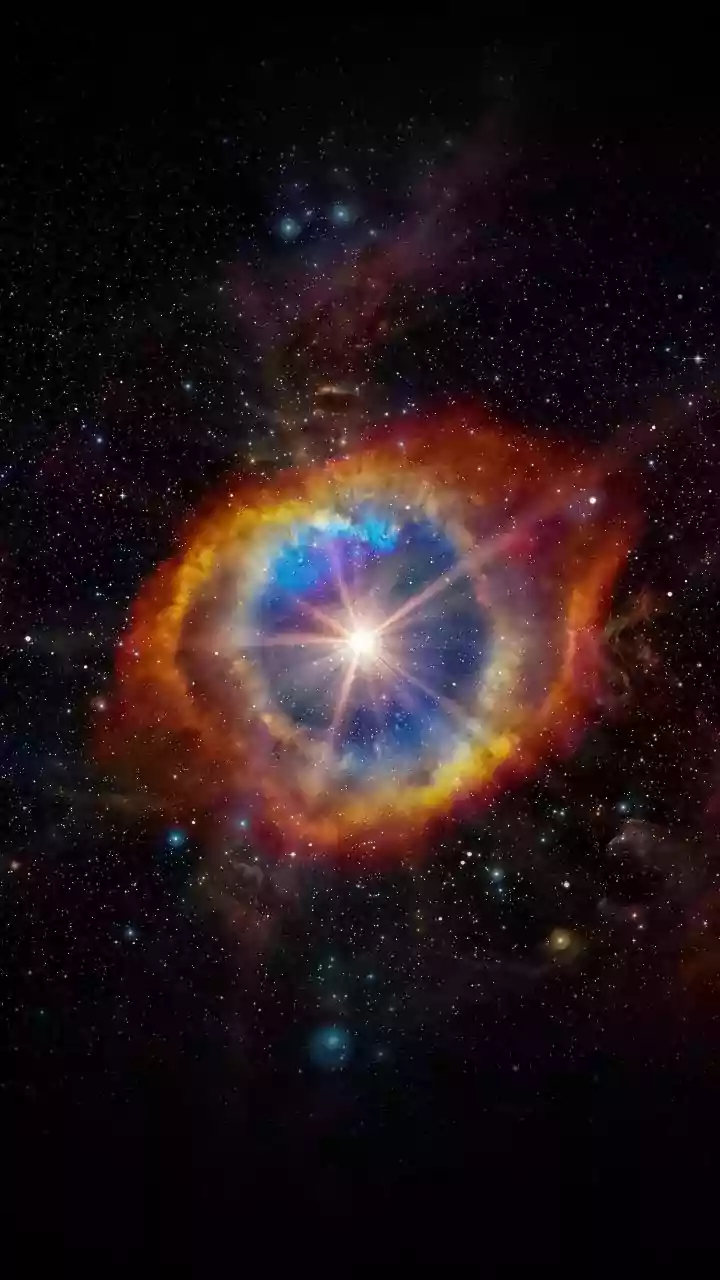
What Kepler and his contemporaries were witnessing was not the birth of a star, but its spectacular death. Today, we know the event as SN 1604, a Type Ia supernova. This type of cosmic explosion happens in a binary star system, where two stars orbit each other. One of these stars is a white dwarf—the tiny, super-dense core left over from a star like our sun. This white dwarf pulls material from its companion star, like a cosmic thief. When the white dwarf accumulates too much mass, it reaches a critical point and triggers a runaway thermonuclear explosion that tears it apart. For a short time, this single event can outshine an entire galaxy.
Shattering the Perfect Heavens
The appearance of a new star, followed by its eventual disappearance, provided powerful evidence against the Aristotelian model of an immutable cosmos. Kepler, along with contemporaries like Galileo Galilei, used observations of the supernova to argue that change did occur in the realm of the 'fixed' stars. By carefully measuring the star's position and noting it showed no parallax—an apparent shift in position when viewed from different locations—they proved it was located far beyond the Moon and planets, deep in the celestial sphere. This was a crucial step in dismantling the old, Earth-centered view of the universe and paving the way for the sun-centered model proposed by Copernicus.
The Legacy of Kepler's Star
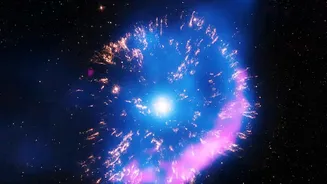
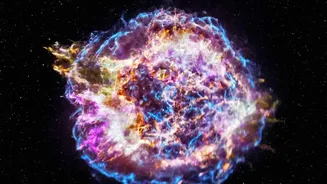
SN 1604 remains the last supernova to have been observed with the naked eye within our own Milky Way galaxy. While others have occurred, they have been obscured by interstellar dust. The next naked-eye supernova, SN 1987A, wasn't seen until 1987 and occurred in a neighboring satellite galaxy, the Large Magellanic Cloud. The remnant of Kepler's Supernova is still an object of intense study today. Powerful modern telescopes like the Chandra X-ray Observatory and the Hubble Space Telescope examine the expanding cloud of gas and dust from the explosion, which is located about 20,000 light-years from Earth. By studying its chemical composition and structure, astronomers gain crucial insights into the life and death of stars and the very expansion of our universe.