


Venus: The Hostile Twin
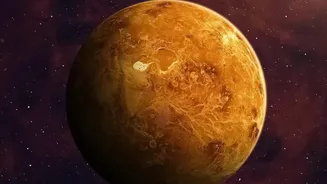
Venus is a planet of extremes and a profound scientific puzzle. Though similar to Earth in size and mass, its path of planetary evolution diverged dramatically. Today, it stands as a cautionary tale, with a runaway greenhouse effect creating surface temperatures
hot enough to melt lead, around 460 degrees Celsius. The planet is perpetually shrouded in a thick, opaque blanket of sulfuric acid clouds, which reflect sunlight and hide the surface from direct observation. This dense, corrosive atmosphere creates a surface pressure more than 90 times that of Earth's, equivalent to being nearly a kilometer deep in our ocean. For decades, these hostile conditions have made Venus incredibly difficult to study, leaving fundamental questions about its geology, climate, and history unanswered.
Enter Shukrayaan: India's Venusian Quest
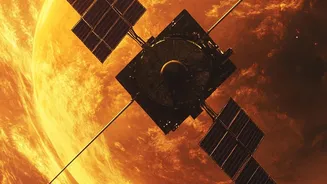
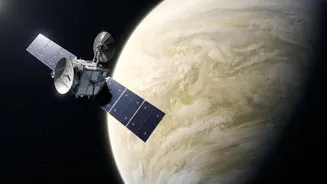
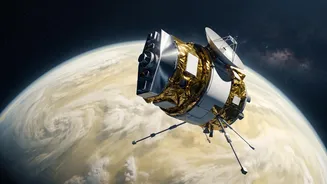
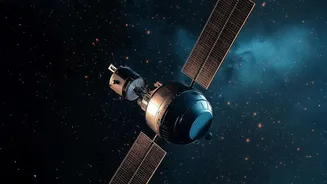
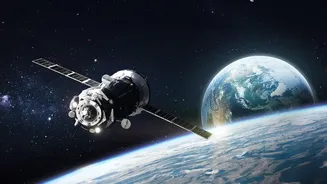
Building on the monumental successes of its lunar (Chandrayaan) and Martian (Mangalyaan) missions, the Indian Space Research Organisation (ISRO) is setting its sights on our other planetary neighbour. The Shukrayaan mission, India's first orbiter to Venus, represents a major step forward in the nation's planetary exploration program. The mission has several primary objectives: to investigate the Venusian surface and subsurface, to study the complex chemistry and dynamics of its atmosphere, and to understand the interaction between the planet and the ever-present solar wind. Following a launch aboard a GSLV rocket, the orbiter will spend over four years making detailed scientific observations from a polar orbit. While launch windows were previously considered for 2024 and 2026, the mission is currently planned for a 2028 launch.
The Challenge of Piercing the Veil
The greatest single obstacle to understanding Venus is its cloud cover. Traditional optical cameras are useless, as they cannot penetrate the dense layers of sulfuric acid. This means that to map the surface and study the lower atmosphere, scientists must rely on technology that can 'see' in wavelengths beyond the visible spectrum. This is where the ingenuity of the Shukrayaan mission's scientific payload comes into play. The mission isn't just about getting to Venus; it's about being equipped with the right tools to uncover secrets that have been hidden for eons. The development of these specialised sensors is crucial to achieving the mission's core scientific goals.
High-Tech Tools for a Hostile World
The flagship instrument aboard Shukrayaan is a high-resolution Synthetic Aperture Radar (SAR). Unlike a regular camera, a SAR works by sending radar pulses through the clouds, which then bounce off the solid surface and return to the orbiter. By analysing these echoes, scientists can create detailed, three-dimensional maps of the terrain, revealing volcanoes, mountains, and other geological features with unprecedented clarity—potentially four times the resolution of NASA's previous Magellan orbiter. Shukrayaan will also carry a ground-penetrating radar, a first for Venus, to probe beneath the surface and study its stratigraphy. To analyse the atmosphere itself, an instrument suite including the Venus Infrared Atmospheric Gases Linker (VIRAL), a collaboration with Russia and France, will study atmospheric chemistry. Other instruments will measure thermal emissions, monitor cloud movements, and even listen for lightning.
Unlocking the Secrets of a Runaway World
With this powerful suite of sensors, scientists hope to answer some of the biggest questions about Venus. Did it once have oceans before its water was lost to space? Is the planet still geologically active, with erupting volcanoes shaping its surface? Data from the radars will provide definitive maps, while atmospheric probes will analyse the chemical composition, looking for trace gases that could hint at ongoing volcanic activity. Ultimately, studying Venus is about more than just one planet. By understanding why Earth's twin turned into such an inhospitable world, scientists can gain invaluable insights into planetary evolution, atmospheric dynamics, and the delicate conditions that make life on our own planet possible. Shukrayaan's findings could serve as a crucial data point in understanding climate change and the long-term future of Earth.