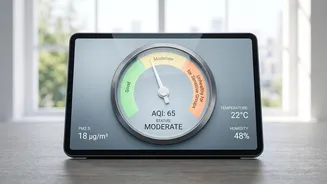









The Air Quality Index, or AQI, is a term we hear often, but what do those numbers mean for our daily lives? When the air is 'hazardous', understanding the risks, especially for vulnerable individuals, is key to staying safe.
Decoding India’s Air Quality Index
The Air Quality Index (AQI)
is a system used to translate complex air pollution data into a single, easy-to-understand number and colour. Managed by the Central Pollution Control Board (CPCB), India's AQI runs on a scale from 0 to 500 and monitors eight key pollutants, including PM2.5 and PM10, which are tiny, harmful particles. The scale is divided into six categories: Good (0-50), Satisfactory (51-100), Moderate (101-200), Poor (201-300), Very Poor (301-400), and Severe (401-500). Each category corresponds to a specific level of health concern, helping the public quickly gauge the air quality in their vicinity.
When 'Hazardous' Air Hits Home
An AQI reading above 300 falls into the 'Very Poor' and 'Severe' categories, often referred to as hazardous. At this level, air pollution poses a serious health risk to the entire population. For those in the 'Very Poor' range (301-400), prolonged exposure can lead to respiratory illnesses. In the 'Severe' range (401-500), the health impacts can be serious even for healthy individuals, and these effects may be felt even during light physical activity. Symptoms can range from coughing and wheezing to more severe irritation of the eyes, nose, and throat, and can significantly worsen existing health conditions.
Who Belongs to 'Sensitive Groups'?
While hazardous air quality is dangerous for everyone, certain 'sensitive groups' are far more vulnerable to its effects. This includes children, whose lungs are still developing and who breathe in more air relative to their body weight. Older adults are also at higher risk, as their bodies may have undiagnosed heart or lung issues and a weaker ability to fight off pollutants. Others in this category include pregnant individuals, as pollution can affect fetal development, and people with pre-existing conditions like asthma, heart disease, or other chronic respiratory illnesses.
Rethinking Everyday Outdoor Trips
When the AQI is hazardous, even simple outdoor trips require careful consideration. Health authorities advise everyone to avoid all outdoor physical activity. This means cancelling or postponing morning walks, jogging, and any form of strenuous exercise. Children should avoid playing outdoors entirely. Commuting can also be risky. If travel is unavoidable, it's recommended to keep vehicle windows closed and set the air conditioning to recirculation mode to minimise exposure to toxic air. The general guidance is to remain indoors as much as possible until the air quality improves.
Essential Steps for Protection
On days with hazardous AQI, taking proactive steps can significantly reduce your health risk. The most important measure is to stay indoors and keep windows and doors closed. If you must go outside, even for a short period, wearing a high-quality N95 mask is strongly recommended to filter out fine particulate matter. Running an air purifier inside your home can also help maintain cleaner indoor air. It's also wise to stay hydrated and monitor realtime AQI levels through official apps and websites like SAFAR and the CPCB's 'Sameer' app, so you can make informed decisions throughout the day.