




Hunting for Water Across Light-Years
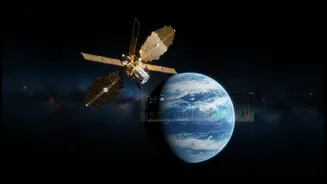
To find water hundreds of light-years away, astronomers become cosmic detectives, analysing faint glimmers of starlight. The primary tool for this is spectroscopy. When a planet passes in front of its star from our perspective, a tiny fraction of the
starlight filters through the planet's atmosphere. Instruments like those on the James Webb Space Telescope (JWST) can break this light down into its constituent colours, creating a spectrum. Different molecules in the atmosphere absorb specific wavelengths of light, leaving behind a unique barcode-like pattern. Water vapour has a distinct and well-known signature in this barcode. The incredible sensitivity of JWST has allowed scientists to spot even subtle traces of water on planets where it was previously difficult to identify, confirming its presence across a wide range of worlds.
An Alien Water Cycle
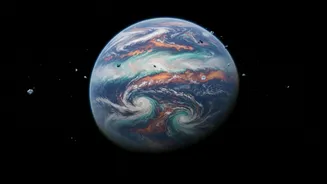
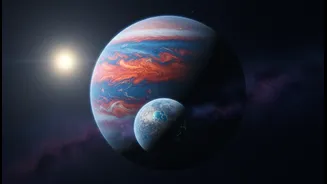
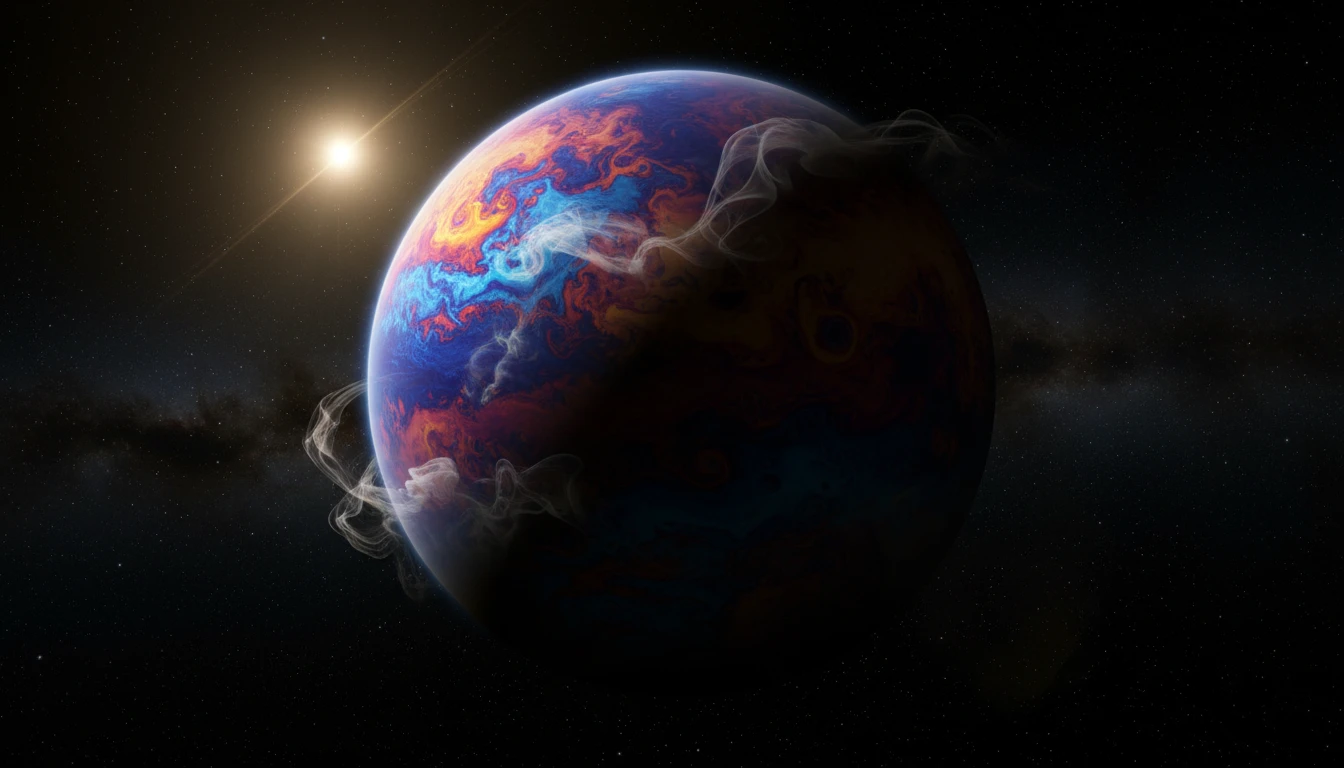
The term “water cycle” on a gas giant paints a very different picture from the familiar rain-and-evaporation loop on Earth. On ultra-hot, Jupiter-like planets such as WASP-121b, the story is far more violent and exotic. These planets are often tidally locked, meaning one side permanently faces the scorching heat of its star while the other is cast in perpetual night. On the blistering dayside, where temperatures can soar to 2,700°C, water molecules are torn apart into their constituent hydrogen and oxygen atoms. Powerful winds, driven by the extreme temperature difference between the day and night sides, then whip these atoms around to the cooler night side. There, temperatures are low enough for the atoms to recombine into water vapour again, before being dragged back to the dayside to repeat the brutal cycle. On these worlds, it never gets cool enough for water to form clouds or rain as we know it; instead, you might get clouds of iron and rain of liquid gems like rubies and sapphires.
Case Study: The Riddles of WASP-18b
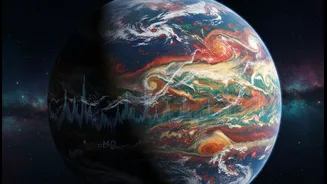
The exoplanet WASP-18b, a gas giant about 10 times more massive than Jupiter, serves as a fascinating natural laboratory. Using JWST, scientists have created detailed temperature maps and have confirmed the presence of water vapour in its atmosphere, despite dayside temperatures hot enough to break down most water molecules. The fact that any water signature is detectable at all speaks to the telescope's extraordinary sensitivity. The temperature map of WASP-18b revealed another puzzle: a massive temperature drop—up to 1,000 degrees—from the hottest point to the terminator, the line between day and night. This suggests that something is preventing the planet’s winds from efficiently distributing heat. One exciting theory is that the planet may possess a strong magnetic field, forcing winds to flow from the equator towards the poles instead of east-to-west, which would be a major discovery in itself.
A Stepping Stone to Habitable Worlds
So, why the intense focus on water in places clearly hostile to life? Studying these gas giants is a critical part of a much larger quest. By analysing the atmospheres of hot Jupiters, scientists can test and refine their models of planetary atmospheres under extreme conditions. This builds the expertise and technological know-how needed to interpret the much fainter signals that will eventually come from smaller, rocky, and potentially habitable planets. Gas giants are easier to observe because of their large size, which blocks more starlight during a transit, making their atmospheric signals stronger. Every discovery, from water vapour to methane, on these massive planets helps perfect the techniques that will be used in the search for biosignatures—signs of life—on Earth-like worlds.
Unlocking the Secrets of Planet Formation
Ultimately, the presence and amount of water on a gas giant tells a story about its birth and evolution. Planet formation theories are complex, but the location of the “snow line”—the distance from a star where it's cold enough for water to freeze—is crucial. Planets that form beyond this line are expected to be rich in ice and, therefore, water. However, studies have found a wide diversity, with some gas giants being surprisingly dry. This diversity challenges existing models and suggests that planetary formation is more complex than once thought. By measuring water abundance, astronomers can piece together whether a planet formed where it is today or if it migrated inward after forming farther out in its solar system. Each detection provides a vital data point, helping to build a more complete picture of how planetary systems, including our own, come to be.