





A Land of Thirsty Fields
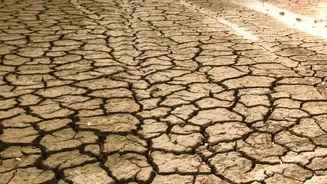
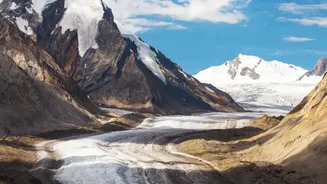
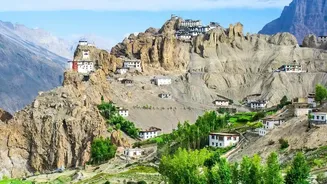
Ladakh, a breathtaking region nestled high in the Himalayas, is a cold desert that receives less than 100 mm of rainfall annually. For centuries, its villages and farms have survived by relying on a predictable natural cycle: the slow melting of mountain
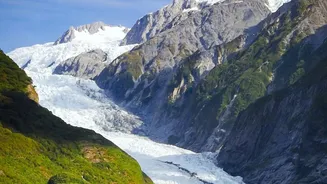
glaciers providing life-giving water for crops during the crucial spring sowing season. However, climate change is disrupting this delicate balance. Rising temperatures are causing glaciers to recede and snow to melt much earlier in the season, when the water isn't needed and often goes to waste. By the time farmers need to plant their barley and apple orchards in April and May, the streams have often dwindled, leading to acute water shortages, failed crops, and threatened livelihoods across the region.
The Mind Behind the Mountain of Ice
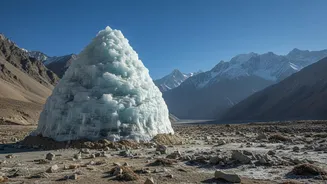
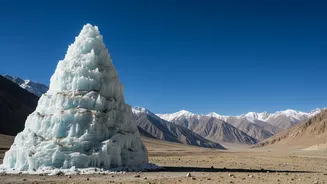
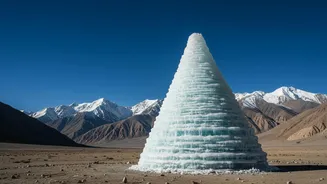
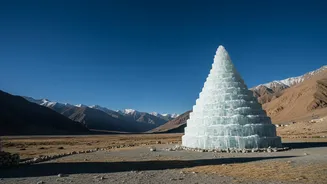
The solution came from local engineer, innovator, and educator Sonam Wangchuk. Observing that ice remained frozen for longer under a bridge, shielded from the sun, he wondered how to store the vast quantities of unused winter stream water until it was needed in the spring. Drawing inspiration from the traditional mound-like Buddhist monuments that dot the Ladakhi landscape, he conceived of the 'ice stupa'. The idea was to create vertical, cone-shaped artificial glaciers. This design ingeniously minimizes the surface area exposed to the sun, allowing the ice to melt much more slowly than a flat, horizontal sheet of ice. Wangchuk and his team at the Students' Educational and Cultural Movement of Ladakh (SECMOL) built the first prototype in 2013, launching a climate adaptation movement.
How to Build a Glacier
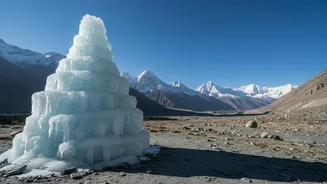
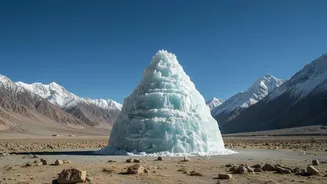
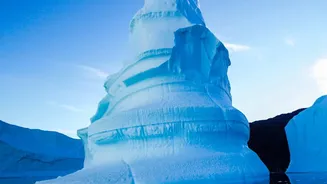
The engineering behind an ice stupa is surprisingly simple and relies on gravity, requiring no electricity or complex machinery. A network of underground pipes channels glacial meltwater from higher altitudes during the frigid winter months. The natural water pressure forces the water up through a vertical pipe in the village, spraying it into the sub-zero air like a geyser. As the water droplets fall, they freeze instantly, gradually forming a massive, cone-shaped mountain of ice. These stupas can tower dozens of metres high and store millions of litres of water that would have otherwise flowed away unused. The process effectively creates a custom-built, low-altitude glacier right where the community needs it most.
From Frozen Art to Lifeline
Come spring, as temperatures rise, the ice stupa begins to melt. Its conical shape ensures it does so slowly and steadily, releasing water right at the start of the critical planting season from April to June. This water is then used to irrigate fields, enabling farmers to sow their crops on time and ensuring food security. The first full-sized stupa provided millions of litres of water, enough to support thousands of newly planted trees. The project has been a resounding success, allowing communities to turn barren desert land green. Beyond agriculture, the initiative has spurred local eco-tourism and engaged community members, making them active participants in securing their own future.
A Solution for the World's Mountains
Since the first successful prototypes, the ice stupa concept has expanded significantly. Dozens of stupas have been built across Ladakh, with the support of the local administration and community participation. The idea has also gained international recognition, with similar projects being tested in other mountainous regions facing similar climate challenges, including Switzerland, Nepal, and Kyrgyzstan. The success of the ice stupa demonstrates the power of simple, low-cost, nature-based solutions. It is a powerful symbol of hope, proving that local innovation can build resilience against the global challenge of climate change, one village at a time.