



The Universe's First Light
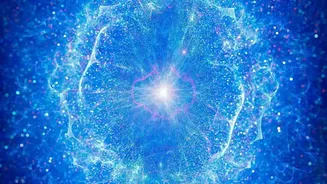
Imagine being able to see the universe just as it was beginning. In a way, we can. All around us, suffusing every corner of space, is the Cosmic Microwave Background (CMB). This is the residual heat left over from the Big Bang, a faint glow that was unleashed
when the universe was only 380,000 years old. Before that moment, the cosmos was a hot, dense, opaque fog of plasma where light couldn't travel freely. As it expanded and cooled, atoms formed, and space became transparent, releasing this ancient light. For decades, studying the CMB has provided overwhelming evidence for the Big Bang theory. It’s the ultimate snapshot of the infant universe, and its near-uniform temperature is a cornerstone of modern cosmology.
The 'Rulebook' of Reality
The 'current theory' mentioned in the headline is the Standard Model of Particle Physics, often combined with cosmology's Lambda-CDM model. Think of it as the incredibly successful, but known to be incomplete, rulebook for reality. It describes the fundamental particles and forces that make up everything we can see and touch. For all its success, however, the Standard Model has major gaps. It doesn't include gravity, and it has no explanation for the mysterious 'dark matter' that holds galaxies together or the 'dark energy' that is causing the universe's expansion to accelerate. Together, these dark components are thought to make up 95% of the universe. So, while the Standard Model is our best guide, physicists know it’s not the final word.
Cracks in the Perfect Picture
When scientists mapped the CMB with incredible precision using probes like the Planck satellite, they expected it to be almost perfectly uniform, with tiny temperature variations that led to the galaxies we see today. It mostly was, but there were also persistent, puzzling anomalies—features that the Standard Model does not predict. These include a massive 'Cold Spot', a hemisphere-spanning temperature imbalance where one side of the sky is slightly different from the other, and other large-scale patterns that don't align with expectations. Another mystery is a phenomenon called 'cosmic birefringence', which suggests the polarisation of this ancient light may have been slightly twisted on its 13.8-billion-year journey to us—a rotation that standard physics can't explain.
Searching for the Cause
So, what could be causing these strange signals? This is where the possibility of 'new physics' comes in. These anomalies could be statistical flukes, but their persistence across multiple observations has led scientists to propose more exotic explanations. The twisting of light, for example, could be caused by interactions with a hypothetical field linked to dark matter or dark energy. Some theories suggest these anomalies might be evidence of cosmic strings—incredibly thin, massive filaments of energy left over from the birth of the universe. Others wonder if they are hints of primordial gravitational waves or even evidence of physics from a time before the Big Bang itself. These ideas are still speculative, but they represent exciting frontiers in our quest to understand the cosmos.
Why This Search Matters
While it might seem abstract, this research touches on the most fundamental questions we can ask: Where did the universe come from, and what are its ultimate laws? The anomalies in the Big Bang's afterglow are like clues left at the scene of a cosmic crime. They tell us our detective work isn't finished and that our main book of suspects—the Standard Model—is missing some key pages. Every great technological and intellectual leap forward in history, from electricity to GPS, has stemmed from this kind of fundamental, curiosity-driven science. By pushing the boundaries of what we know, we not only get a clearer picture of the universe but also lay the groundwork for the discoveries of tomorrow.