



More Than Just a Pretty Picture
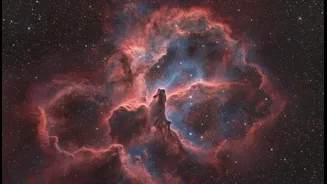
First captured by the Hubble Space Telescope in 1995, the image officially known as the Eagle Nebula (or M16) immediately captivated the world. Its nickname, the 'Pillars of Creation,' points to its role as a stellar nursery, a place where new stars are
born. Located about 6,500 light-years from Earth, these colossal structures are not solid rock but immense columns of cool interstellar hydrogen gas and dust. The tallest pillar is an astonishing five light-years high, more than double the distance from our sun to its nearest stellar neighbour. But while their name evokes a sense of calm genesis, these pillars are at the heart of an incredibly dynamic and violent process, making them pillars of destruction as well as creation.
A Stellar Nursery in Chaos
Within these dense, dark columns, gravity is pulling clumps of gas and dust together. As these knots gain mass, they collapse under their own weight, heat up, and eventually ignite to form new stars. The tips of the pillars glow as the fledgling stars inside begin to emerge from their dusty cocoons. In essence, the image provides a stunning snapshot of the very first stages of a star's life, a process fundamental to understanding how galaxies and even our own solar system evolved. However, this nursery is not a peaceful one. The pillars themselves are under constant assault from forces that are actively tearing them apart.
The Unseen Destructive Force
Just off-screen, above the top of the pillars, lies a cluster of massive, hot young stars. These stellar behemoths unleash a torrent of intense ultraviolet radiation. This radiation heats the surface of the cold gas pillars, causing the material to boil away into space in a process astronomers call 'photoevaporation'. You can see this happening in the ghostly streamers of gas that seem to float away from the main structures. The radiation is so powerful that it's actively eroding and sculpting the pillars. The densest parts of the pillars are able to shadow the gas behind them, which is what creates their long, finger-like shapes against the onslaught. It’s a cosmic battle between the destructive power of established stars and the creative force of gravity forming new ones.
Seeing in a New Light
To better understand this complex environment, Hubble revisited the pillars and captured them in near-infrared light in addition to visible light. This new perspective was transformative. While visible light shows the glowing, colorful surfaces of the gas clouds, infrared light can pierce through much of the obscuring dust. The infrared image turns the pillars into eerie, translucent silhouettes against a backdrop crowded with countless stars. Most importantly, it reveals the newborn stars that were previously hidden deep inside the dusty columns, appearing as bright, shining sources within the structure. This dual view, made possible by Hubble's advanced technology, provides a more complete picture, showing both the gas being destroyed on the outside and the stars being born on the inside.
A Glimpse Into Our Universe's Story
Looking at the Pillars of Creation is like looking back in time—not just because the light took 6,500 years to reach us, but because it shows us a process similar to how our own Sun likely formed billions of years ago. The cycle of star birth and destruction is fundamental to the cosmos. Stars are the universe's factories, creating the heavier elements that eventually form planets and, on at least one world, life. Studying stellar nurseries like the Eagle Nebula helps scientists refine their models of star formation and better understand our own cosmic origins. The image may even be a ghost; some astronomers speculate that a supernova from one of the massive nearby stars could have already destroyed the pillars thousands of years ago, but the light from that event has yet to reach us.