
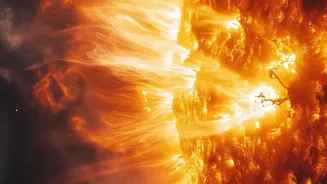
A New Solar Whirlpool
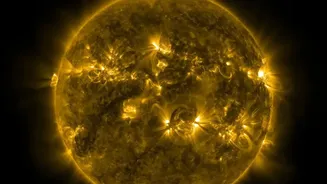
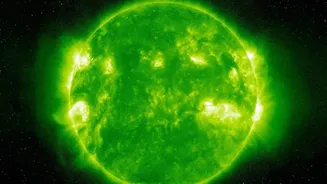
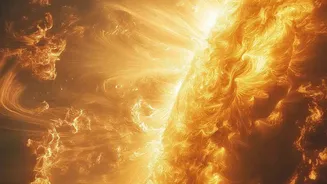
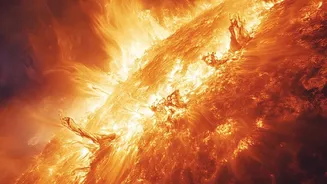
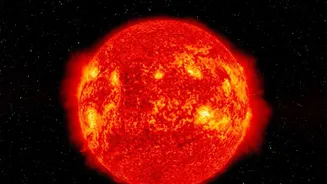
Scientists have captured the most detailed images ever taken of the Sun's surface, revealing tiny, swirling vortices of plasma that were previously invisible. These whirlpools, some as small as 20 kilometres wide, are the result of a phenomenon known
as Kelvin-Helmholtz instability. This occurs when two fluids, or in this case plasmas, move past each other at different speeds, creating a shear force that curls into wave-like vortices. It’s a process we see in breaking ocean waves and certain cloud formations on Earth, but observing it on the Sun's surface at this scale is a major breakthrough. The discovery was made using the Daniel K. Inouye Solar Telescope in Hawaii, the most powerful solar observatory on the planet. Its ability to resolve such fine details is like being able to spot a small coin from over 100 kilometres away.
What Makes These Waves Special?
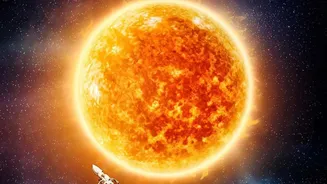
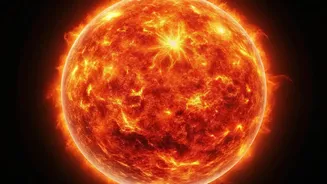
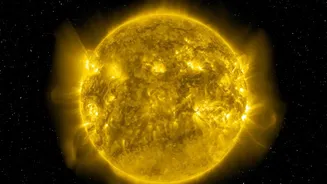
The Sun's visible surface, or photosphere, is a landscape of bubbling patterns called granules. Each granule, which can be over 1,000 kilometres across, is the top of a convection cell where hot plasma rises from the interior, cools, and sinks back down. The newly observed vortices appear at the edges of these granules. For the first time, scientists could directly see these small-scale instabilities on the sun's surface. While larger waves, sometimes called solar tsunamis or Moreton waves, have been known for decades, they are typically associated with massive explosions like solar flares. These newly seen vortices, however, seem to be a constant feature, suggesting they are a fundamental part of how energy moves around on the Sun.
Solving a Burning Mystery
One of the longest-standing puzzles in solar physics is the coronal heating problem: why is the Sun's outer atmosphere, the corona, millions of degrees hotter than its surface, which is a mere 5,500 degrees Celsius? Scientists have long suspected that magnetic waves play a key role in transporting energy from the surface to the corona. These newly discovered vortices provide a crucial piece of that puzzle. The observations show how the swirling motions of the plasma twist and tangle magnetic field lines. This process builds up magnetic energy, which can then be released, potentially heating the corona and driving other solar phenomena. These vortices could act as the 'motors' that inject the energy needed to sustain the corona's extreme temperatures.
Why This Solar Puzzle Matters on Earth
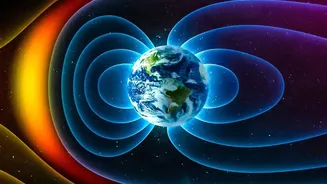
Understanding the Sun's behaviour isn't just an academic exercise. The Sun drives space weather, releasing streams of charged particles known as the solar wind and occasionally unleashing powerful solar flares and coronal mass ejections (CMEs). These events can have significant impacts on Earth, disrupting GPS signals, damaging satellites, and even threatening power grids. By understanding the fundamental processes that build up and release energy on the Sun, like these newly observed plasma waves, scientists can improve their ability to predict major solar events. The clues offered by these tiny vortices could lead to better forecasting, giving us more time to prepare for and mitigate the effects of violent space weather. The discovery marks a major step forward in our ability to model how our star works and how it affects our technologically dependent world.