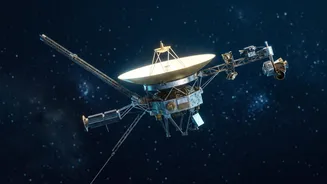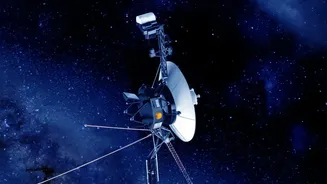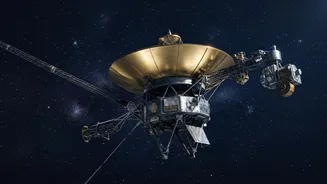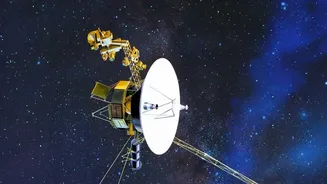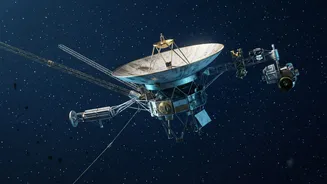





For two tense days, humanity’s most distant emissary was silent. NASA lost contact with Voyager 1, the almost 50-year-old probe in interstellar space. But contact has been restored, just ahead of a historic milestone.
An Anxious Silence
In mid-October 2026, NASA’s Deep Space
Network—a global array of giant radio antennas—reached out to listen for Voyager 1 during two scheduled communication attempts, 24 hours apart. It was met with silence. For 48 hours, the intrepid probe, currently travelling through interstellar space more than 25 billion kilometres away, was on its own. The silence was alarming. At its extreme distance, any command sent from Earth takes nearly 24 hours to reach the spacecraft, and another 24 hours are needed to hear a reply. This two-day communication lag makes any problem incredibly difficult to diagnose and fix.
The Probe That Fixed Itself
Before engineers at NASA's Jet Propulsion Laboratory could even send troubleshooting commands, Voyager 1’s signal reappeared on October 20. The probe had, in essence, saved itself. The investigation so far reveals that the spacecraft’s onboard computers detected an issue with a primary group of thrusters, which are small rocket engines that control its orientation. Following its programming, Voyager 1 automatically switched to a backup set of thrusters. This action triggered a 'fault protection' mode, a safe state designed to stabilize the spacecraft and pause normal operations to give engineers time to assess the situation. While the team is relieved, they are still investigating the root cause of the thruster issue.
The One-Light-Day Milestone
The communication scare came just weeks before a monumental achievement. On November 18, 2026, Voyager 1 will become the first human-made object to be one light-day away from Earth. A light-day isn't a measure of time, but of distance: it's how far light travels in 24 hours, which is approximately 25.9 billion kilometres. To put that in perspective, the Moon is only about 1.3 light-seconds away, and the Sun is 8.3 light-minutes away. Crossing this threshold won’t change anything for the spacecraft itself, but it marks a profound moment in human exploration, cementing just how far our reach has extended into the cosmos.
An Aging But Hardy Explorer
Launched in 1977, Voyager 1 has long outlasted its original mission to study Jupiter and Saturn. Its cameras were switched off in 1990 to save power after taking the iconic 'Pale Blue Dot' photo of Earth. The probe is powered by radioisotope thermoelectric generators, which convert heat from decaying plutonium into electricity. This power source loses about four watts of energy per year, forcing NASA to be creative. In early September 2026, engineers executed a complex power-saving maneuver nicknamed the 'Big Bang', swapping out devices to extend the life of the remaining two active science instruments, which study plasma waves and magnetic fields. This recent glitch is just another chapter in the long life of a resilient machine that engineers expect to keep learning from for years to come.