




An Object of Interest
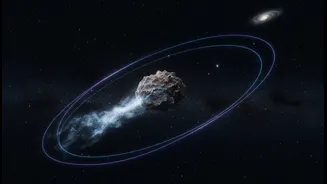
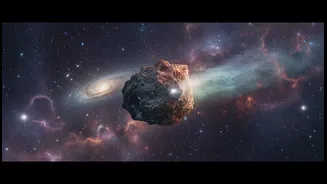
The object at the centre of this cosmic puzzle is (248370) 2005 QN173. At a glance, it's just one of over half a million known asteroids in the main asteroid belt, that vast expanse of rock and dust orbiting between Mars and Jupiter. For years, it behaved
exactly as expected for a main-belt asteroid: a quiet, inactive chunk of rock on a predictable, near-circular path around the Sun. Scientists classified it as a dark, carbonaceous C-type asteroid, a common type in the outer belt, and thought little more of it. But recent observations have turned this simple classification on its head, revealing that 2005 QN173 was hiding an icy secret.
The Great Cosmic Divide
To understand the significance, it’s important to recall the textbook difference between asteroids and comets. Asteroids are primarily rock and metal, formed closer to the Sun where it was too warm for ice to survive. They are mostly confined to the asteroid belt. Comets, on the other hand, are often called “dirty snowballs” because they are composed of rock, dust, and abundant water ice. They formed in the frigid outer reaches of the solar system, in places like the Kuiper Belt and the Oort Cloud. Their highly elliptical orbits bring them close to the Sun, where the heat causes their ice to sublimate—turn directly into gas—creating the beautiful coma (a temporary atmosphere) and tail that make them so recognisable.
A Ghostly Tail Appears
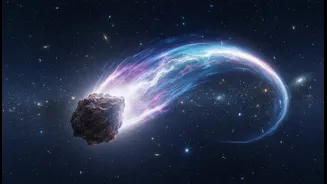
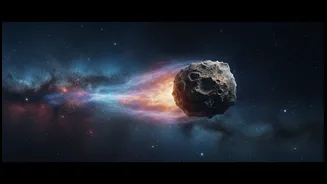
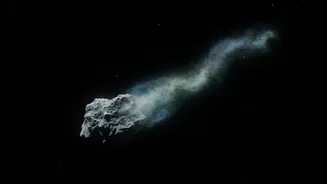
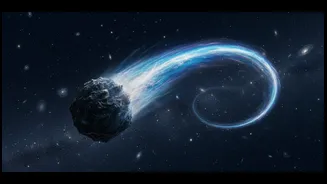
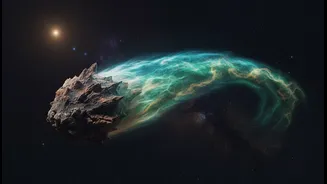
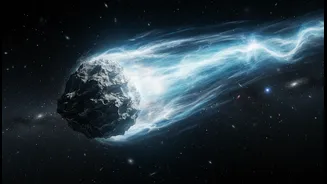
The surprise came when astronomers pointed telescopes at 2005 QN173 and saw something that shouldn’t be there: a long, faint tail stretching over 700,000 kilometres. This wasn't a one-time event. Archival images confirmed the asteroid had shown similar activity during a previous pass near the Sun. This recurrent behaviour is a strong indicator that the activity is driven by the sublimation of ice, just like a comet. This discovery was shocking because objects in the relatively warm asteroid belt are not expected to have retained surface ice for billions of years. The discovery has now earned it a dual designation as both an asteroid and a comet, officially named 433P/2005 QN173.
A New Class of Celestial Body
This object is a member of a rare and fascinating new category: an "active asteroid" or "main-belt comet". These are objects with the orbit of an asteroid but the physical characteristics of a comet. Fewer than two dozen such objects have been confirmed, making each new discovery incredibly valuable. The prevailing theory is that these are not new arrivals but ancient residents of the asteroid belt that formed with significant amounts of water ice. This ice was likely preserved for eons, buried beneath a protective layer of dust. A small impact from another space rock, or perhaps thermal stress from the Sun's warming, could have recently exposed the buried ice, allowing it to sublimate and create the observed tail.
Why Redefining Small Worlds Matters
The existence of active asteroids like 2005 QN173 has profound implications. Firstly, it suggests the asteroid belt may contain far more water ice than previously believed. This discovery supports the theory that Earth’s water may have been delivered by asteroids from this region billions of years ago. Secondly, it presents an exciting opportunity for future space exploration. Water is a critical resource for everything from life support to rocket fuel. If water-rich asteroids are hiding in plain sight in the relatively nearby asteroid belt, they become prime targets for in-situ resource utilization, potentially making long-duration space missions more feasible. These hybrid objects are no longer just curiosities; they are clues to our planet's past and keys to our future in space.