


A Familiar Celestial Neighbour
Centaurus A is no stranger to astronomers. At a distance of about 11 to 12 million light-years away, it's practically in our cosmic backyard and one of the brightest radio sources in the sky. For decades, telescopes like Hubble have captured its most
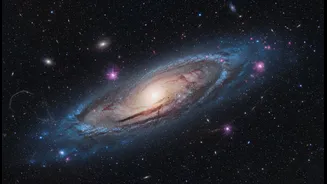
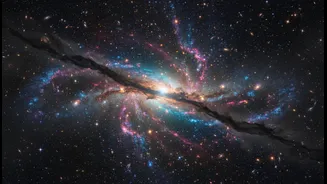
striking feature: a dark, dramatic lane of interstellar dust bisecting a huge elliptical blob of older, yellow-red stars. It’s what scientists call a "peculiar galaxy," a strange structure that is the result of a violent past. This galaxy was formed when a large elliptical galaxy devoured a smaller spiral galaxy millions of years ago, an event that left behind the iconic warped disc of gas and dust. While we knew the basic story, the dust and gas obscured the finer details of the carnage and subsequent creation. That is, until Webb turned its golden eye towards it.
Piercing the Veil of Dust
Where the Hubble Space Telescope sees an opaque silhouette of dust, the James Webb Space Telescope sees a glowing, translucent curtain. This is Webb’s superpower: its ability to detect infrared light. This longer wavelength of light can pass through clouds of dust and gas that would normally block our view in the visible spectrum. Using its Near-Infrared Camera (NIRCam) and Mid-Infrared Instrument (MIRI), Webb has provided an unprecedented look into the heart of Centaurus A. The iconic dust lane is no longer a dark void but a complex, fiery structure. We can now see the distribution and temperature of the gas and dust with stunning clarity, revealing the raw materials for future generations of stars. What once looked like a hazy glow is now a crowded landscape of countless individual stars.
The Engine at the Center
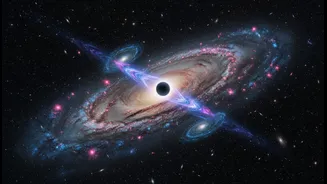
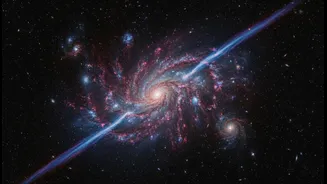
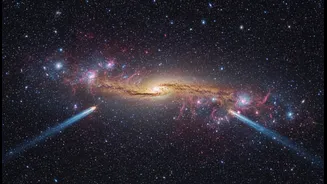
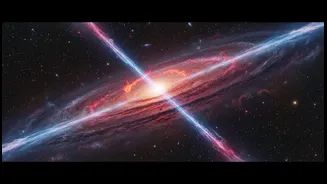
At the core of Centaurus A lies a supermassive black hole, an invisible monster about 55 million times more massive than our sun. This isn't a quiet black hole; it's an active galactic nucleus (AGN) that is furiously consuming matter. As gas and stars spiral into its maw, the black hole blasts out colossal jets of material at nearly the speed of light. While radio telescopes have mapped these jets extending far beyond the galaxy, Webb’s infrared sensitivity allows scientists to study the jet's interaction with the surrounding gas in never-before-seen detail. Webb's data shows fast-moving ionized gas being pushed outward by the black hole’s activity, offering new clues about how these powerful engines can shape an entire galaxy.
A Firestorm of Creation
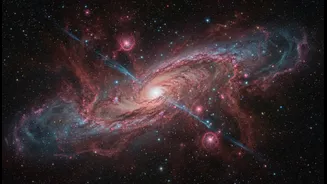
The galactic collision that formed Centaurus A was not just destructive; it was also incredibly creative. The shockwaves from the merger compressed vast clouds of gas, sparking a furious burst of star formation. Webb's new images showcase these stellar nurseries with exquisite resolution. In the dusty disc, we can see bright clumps and filaments where thousands of young, hot stars are being born. The mid-infrared view is particularly revealing, highlighting the glowing reddish dots that signify dust-rich stars or stellar nurseries. By studying the structure and composition of these regions, astronomers can build a more complete model of how starbursts are triggered and sustained following galactic mergers. This process is fundamental to how galaxies grow, and Centaurus A provides a perfect, close-up laboratory.
More Than Just a Pretty Picture
The true power of the Webb imagery comes from combining its data with observations from other telescopes. By layering Webb's infrared view with Hubble's visible light data and Chandra's X-ray observations, scientists create a holistic, multi-wavelength picture of Centaurus A. Each part of the electromagnetic spectrum tells a different part of the story. X-rays show high-energy phenomena near the black hole, visible light shows the stars, radio waves trace the massive jets, and now infrared reveals the hidden fuel for stars. This ability to study the galaxy star by star allows for a form of galactic archaeology, reconstructing a timeline of its evolution. It transforms our understanding of how black holes and their host galaxies evolve together.