



What is the Carrom Ball?
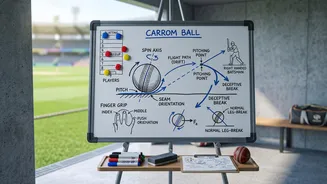
The carrom ball is a special type of delivery in cricket, so named because the bowler flicks the ball in a way that mimics a player flicking a striker on a carrom board. Unlike a conventional off-break or leg-break, which is imparted by the wrist or the roll
of the fingers, the carrom ball is 'squeezed' out from between the thumb and a bent middle finger. This unconventional release is the secret to its deception. To the batsman, the bowler’s action might look like a standard off-spinner, but the ball that comes out can behave very differently. It can go straight on, skid faster, or even turn in the opposite direction to what is expected.
The All-Important Grip
Everything starts with the grip. To bowl a carrom ball, the bowler holds the cricket ball firmly between their thumb, index finger, and a bent middle finger. The middle finger is curled inwards, almost like a claw, pressing against the ball. The thumb provides support from the opposite side. This grip is fundamentally different from a classic spinner's grip, where the fingers are spread more naturally across the seam. The name itself—which Indian spinner Ravichandran Ashwin calls the 'sodukku ball' (finger snap in Tamil)—is a direct reference to this unique flicking motion used to propel the ball forward.
The Science of the Flick
The magic happens at the moment of release. Instead of rolling the ball over the fingers, the bowler executes a sharp, sudden flick, snapping the bent middle finger straight. This action imparts a very specific type of spin. Because the ball is pushed out from the front of the hand with a flick, it often has a scrambled seam and fewer revolutions than a traditionally spun delivery. This lack of heavy spin is actually a key part of its effectiveness. A ball with fewer revolutions doesn't 'grip' the pitch as much, causing it to skid on with pace. It denies the batsman the reaction time they are used to when facing a spinner. The force generated is all in the fingers, not the wrist or arm action, which must remain identical to a normal delivery to ensure complete disguise.
Deception, Drift, and Direction
The ultimate goal of the carrom ball is deception. A batsman reads cues from a bowler's hand and wrist to predict which way the ball will turn. The carrom ball disrupts this process. The direction of its break is determined by the positioning of the flicking finger at release. A bowler can make it spin like a leg-break (away from a right-hander) or an off-break (into a right-hander), or impart backspin that causes it to go straight on. This is where physics, specifically the Magnus effect, comes into play. The spin creates a pressure differential in the air on either side of the ball, causing it to drift or swing before it even pitches. A batsman expecting a conventional off-break that turns into them might be completely undone by a carrom ball that holds its line or turns away.
The Masters of the Craft
While Australian Jack Iverson is credited with first using the technique in the 1950s, it was Sri Lanka's Ajantha Mendis who brought the carrom ball to global prominence in 2008, famously dismantling a powerful Indian batting lineup to win the Asia Cup. Mendis’s mystery spin baffled batsmen worldwide. In the modern era, India's Ravichandran Ashwin has become the foremost exponent of the delivery. He has not only mastered the original technique but has developed several variations of it, using different angles and seam positions to keep batsmen constantly guessing. Other notable practitioners who have used this delivery to great effect, especially in the T20 format, include Sunil Narine of the West Indies and Sri Lanka's Maheesh Theekshana.