


The Prime Suspects: Rocky Planets
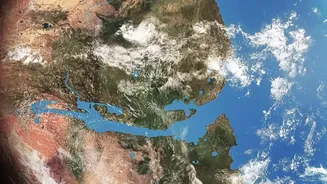
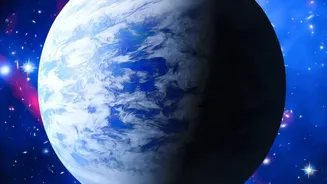
For decades, scientists have focused their search on rocky planets similar in size to Earth that orbit within their star's 'habitable zone'. This is the 'Goldilocks' region where conditions are just right—not too hot and not too cold—for liquid water
to potentially exist on a planet's surface. Hopes were high that JWST would quickly find Earth-like worlds with steamy, water-rich atmospheres. The telescope uses a technique called transmission spectroscopy, analysing starlight as it filters through a planet's atmosphere during a transit. Different molecules absorb light at specific wavelengths, leaving a unique chemical fingerprint. This method promised to reveal the atmospheric composition of these prime candidates, but the story is proving to be far more complex and surprising than anticipated.
A Surprising Absence of Atmospheres
One of the most significant early revelations from JWST is what it hasn't found. Many rocky exoplanets orbiting close to small, cool M-dwarf stars—the most common type of star in our galaxy—appear to have no substantial atmosphere at all. Planets in the famous TRAPPIST-1 system, located just 40 light-years away, were prime targets. However, observations of the inner planets TRAPPIST-1 b and TRAPPIST-1 c showed no evidence of a thick, puffy atmosphere. This trend continued with other worlds like GJ 1132 b, where extensive observations finally settled a long-standing debate, confirming the planet is almost certainly an airless rock. The leading theory is that the intense radiation and stellar winds from their parent M-dwarf stars have stripped these worlds of their gaseous envelopes over billions of years.
The Problem of Stellar Contamination
The search for water is also a scientific detective story filled with red herrings. In some cases, initial data hinted at the presence of water vapour, only for further analysis to suggest a different culprit: the star itself. On the planet GJ 486 b, an initial tantalising hint of water was detected. However, scientists realised that cool spots on the surface of the host star could mimic the spectral signature of water in a planet's atmosphere as it transits. This 'stellar contamination' is a major challenge, forcing astronomers to develop sophisticated models to distinguish between a signal from the planet and a signal from its star. This careful work is essential to avoid false positives in the monumental search for habitable worlds.
Water in the Making
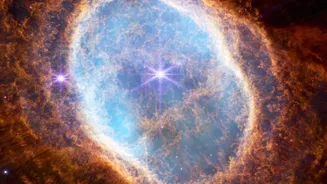
While finding water on mature rocky planets has been challenging, JWST has confirmed its presence in the very places where such planets are born. In the PDS 70 system, the telescope detected water vapour in the inner disk of gas and dust where rocky, terrestrial planets are thought to be forming. This was the first time water was detected in the terrestrial region of a disk already known to host planets. This discovery is incredibly exciting because it implies that planets like Earth can have water available from the very beginning of their formation. It suggests that the building blocks of life are present in these stellar nurseries, even if the final planets struggle to hold onto their atmospheres.
A New Kind of Water
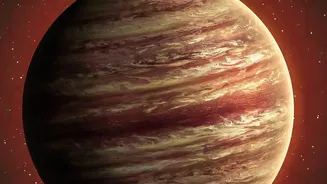
In a fascinating twist, Webb has also detected a different type of water, known as 'semi-heavy water' or HDO, in the atmosphere of a gas giant exoplanet called WASP-39b. This variant has one of its hydrogen atoms replaced by a heavier version called deuterium. The high ratio of heavy to normal water suggests two possibilities: either the planet formed far out in its solar system where heavy-water ice is more common before migrating inwards, or intense stellar radiation has slowly boiled away the lighter, regular water over eons, leaving the heavier version behind. While WASP-39b is not a rocky world, developing the techniques to measure these isotopes is crucial practice for when Webb turns its gaze to smaller, more Earth-like planets where such a ratio could provide clues about their history and potential habitability.