





The Great Sky Illusion
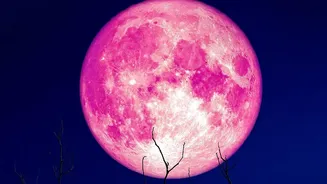
First, let's be clear: the moon doesn't actually change size. If you were to take a photograph of the moon near the horizon and another when it's high overhead, they would be identical in measurement. The phenomenon, known for centuries as the 'Moon Illusion',
is a powerful trick happening entirely inside our heads. It has baffled thinkers from Aristotle to modern neuroscientists, but the consensus is that it's an error in perception, not a physical change in the sky. Your brain, in its attempt to make sense of the visual world, is being fooled by its own clever rules. The question isn't why the moon gets bigger, but why our brains make it seem so.
Your Brain Thinks the Horizon is Far Away
The leading explanation is called the Apparent Distance Hypothesis. This theory suggests our brains use environmental cues to judge distance. When the moon is on the horizon, it's surrounded by trees, buildings, and mountains—objects whose sizes we know. Our brain sees the moon behind these familiar objects and processes it as being very far away. However, when the moon is high up in the vast, empty night sky, there are no reference points. Lacking these cues, our brain perceives the sky overhead as being closer than the sky at the horizon. This concept is sometimes called the 'flattened sky dome'. Essentially, we see the sky not as a perfect hemisphere above us, but as a somewhat squashed bowl.
Enter the Ponzo Illusion
To understand how perceived distance alters perceived size, consider a classic optical illusion called the Ponzo Illusion, first described by Mario Ponzo in 1911. Imagine two identical lines drawn on a pair of converging railway tracks. The line closer to the converging point (the 'farther' one) will appear larger than the one closer to you, even though they are the same length. Our brains use the converging tracks as a perspective cue, interpreting that if two objects at different distances have the same retinal image size, the one that appears farther must be physically larger. The Moon Illusion works similarly: because we perceive the horizon moon as being 'farther' away (like the top line on the railway tracks), our brain scales it up, making it look enormous to compensate for the perceived distance.
The Unchanging Angular Size
From a scientific standpoint, the size of an object in our vision is measured by its 'angular size'—the angle it covers in our field of view. The moon's angular size is consistently about half a degree, whether it's on the horizon or at its zenith. This is a physical fact that you can prove by holding a small object like your pinky finger at arm's length; the moon will be about half the width of your nail regardless of its position. The fact that its angular size doesn't change proves the illusion is not caused by atmospheric magnification, which would actually make the horizon moon appear slightly smaller and more squashed. The discrepancy between the constant angular size and our changing perception is the very definition of the illusion.
A Flaw in an Otherwise Brilliant System
So, why does our brain do this? This perceptual 'glitch' is a side effect of a normally brilliant system called size constancy. Size constancy is what allows you to perceive a friend as being the same size whether they are standing next to you or walking away down a street. Your brain automatically accounts for the distance and scales their image accordingly so they don't appear to 'shrink'. This system works perfectly for terrestrial objects but gets confused by celestial ones like the moon, which are at a distance our brains can't truly compute and lack the usual environmental context. NASA astronauts in orbit, who have no foreground objects to use for scale, have also reported experiencing the Moon Illusion, suggesting there may be even more complex processes at play.