
A Storm Unlike Any Other
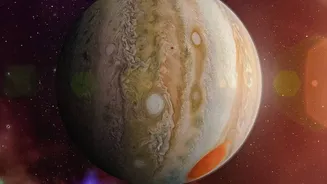
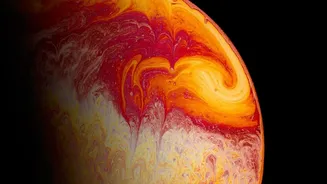
For at least 150 years, and possibly longer, astronomers have tracked a colossal, churning storm in Jupiter's southern hemisphere. Known as the Great Red Spot, this massive anticyclone is a high-pressure system so vast it could easily swallow our entire
planet. With wind speeds at its outer edge exceeding 640 kilometres per hour, it dwarfs any hurricane ever recorded on Earth. This enduring tempest, trapped between two powerful jet streams, has long been a symbol of the raw and turbulent power of gas giants. But despite its apparent permanence, this iconic feature is far from static. For decades, scientists have noted that the storm is shrinking, but recent observations have uncovered a new layer of complexity to its behaviour.
The Wiggle of a Cosmic Giant
The latest insights come from a dedicated observation campaign by the Hubble Space Telescope. High-resolution images captured over a 90-day period revealed that the Great Red Spot is not just drifting and shrinking, but it is also oscillating in unexpected ways. Astronomers describe the motion as a 'jiggle', similar to a bowl of gelatin. During this cycle, the storm's shape fluctuates, squeezing in and out, while its rotational speed also accelerates and decelerates. According to Amy Simon of NASA's Goddard Space Flight Center, this oscillation in size had not been identified before, and there are currently no hydrodynamic models to explain this surprising new 'wobble'. This finding suggests that the internal dynamics of the solar system's largest storm are far more complex and active than previously understood.
Eyes on Jupiter: A Legacy of Observation
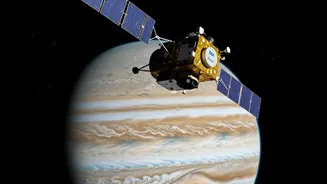
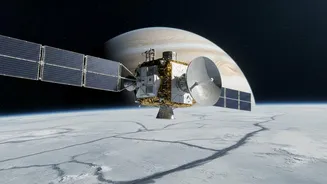
These new discoveries are possible thanks to the remarkable capabilities of instruments like the Hubble Space Telescope. As part of the Outer Planet Atmospheres Legacy (OPAL) program, Hubble provides yearly global views of our solar system's outer planets, allowing scientists to monitor long-term changes in their storms, winds, and clouds. The recent, more focused study on the Great Red Spot provided an imaging cadence—a rate of taking pictures—that was perfect for capturing the 90-day oscillation cycle for the first time. This high-resolution, time-lapse perspective allows astronomers to move beyond static snapshots and create detailed movies of the storm's behaviour, revealing subtle motions that would otherwise be missed. These powerful observations are complemented by other missions, like NASA's Juno spacecraft, which has performed close flybys to measure the storm's incredible depth—now known to extend over 300 kilometres below the cloud tops.
The Shrinking Storm and its Future
The newly observed oscillations are happening against the backdrop of a much longer-term trend: the Great Red Spot is shrinking. Historical observations from the late 1800s estimated the storm was about 40,000 kilometres across, wide enough to fit three Earths side-by-side. By the time the Voyager probes flew by in 1979, it had shrunk to about 23,000 kilometres. Recent Hubble images show it is now less than 16,000 kilometres across, and its shape has become more circular as it has contracted. Scientists have hypothesized that the shrinking could be caused by smaller eddies being absorbed into the main storm, altering its internal energy. The current thinking is that the storm will likely continue to shrink until it stabilises into a more circular shape that fits neatly within its latitudinal band, where the surrounding winds will hold it in place.