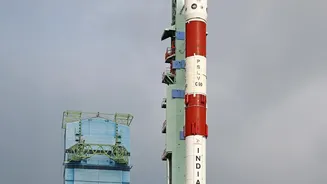









The Anatomy of an Escape
Before diving into the 'how', it's important to understand the 'what'. An emergency escape sequence, or launch abort, is a critical safety procedure designed to save the crew if the rocket fails on the launchpad or during its ascent. The Gaganyaan mission
uses a Crew Escape System (CES), a specialised set of powerful, quick-acting solid-fuel motors attached to the top of the crew module. If the onboard computers detect a catastrophic failure—like a loss of thrust or a dangerous deviation from the flight path—the CES is triggered automatically within milliseconds. Its job is to violently pull the crew module away from the failing launch vehicle, getting the astronauts to a safe distance as quickly as possible. This entire sequence, from detection to separation, is a high-G, high-stress event that must function perfectly under the worst possible conditions.
A Lifeline of Independent Power
Once the Crew Escape System fires, the crew module is on its own. It is completely severed from the launch vehicle, which means it is also cut off from the rocket's power supply. To handle this, the module is equipped with its own independent and robust power systems. For the unpressurised test flights, ISRO confirmed the avionics systems—which cover navigation, sequencing, and power—are configured in a dual-redundant mode. This means there are at least two of everything, ensuring that if one power line or battery fails, another is ready to take over instantly. The primary source of this emergency power comes from dedicated, high-reliability batteries stored within the crew module itself. These are not the same batteries that would power the module in orbit; they are specifically designed for the unique, short-duration, high-demand needs of an abort sequence and subsequent recovery. This ensures that all essential systems, from flight computers to communication equipment, remain active until the crew is safely recovered.
Maintaining the Crucial Signal
Power is useless without communication. During an escape, the astronauts and mission control need an unbroken link to monitor the situation and coordinate recovery. Like its power systems, the crew module’s communication and telemetry links are entirely self-contained and designed with redundancy. The module houses its own S-band radio systems and dedicated backup channels for this exact scenario. During normal flight, the spacecraft communicates through a vast network of ground stations, including international partners like the European Space Agency (ESA) and even commercial services like Amazon Web Services, to ensure constant contact. In an abort, the crew module's own transmitters take over, broadcasting vital health and location data. After it splashes down in the ocean, a Crew Module Uprighting System (CMUS) uses gas-powered flotation devices to ensure the capsule stays upright, keeping its communication antennas pointed towards the sky for recovery teams to home in on.
Testing for Every Possibility
This intricate web of power and communication systems isn't just theoretical. ISRO has rigorously tested these life-saving measures in real-world demonstrations. The Pad Abort Test (PAT) in 2018, for instance, simulated a launchpad emergency, where the escape system lifted a simulated crew module to an altitude of 2.7 km before it parachuted safely into the Bay of Bengal. More recently, the Test Vehicle Abort Mission-1 (TV-D1) demonstrated a successful in-flight abort at high speed and altitude. In this test, an unpressurised crew module, equipped with its own redundant avionics for power and telemetry, separated from its booster at an altitude of 17 km. It then executed its parachute deployment sequence and was successfully recovered by the Indian Navy. These tests captured huge amounts of data from hundreds of sensors, proving the reliability of the separation mechanisms, autonomous sequences, and recovery systems.