


The Death of a Sun-Like Star
Most stars in the universe, including our own Sun, will end their lives not with a bang, but with a whimper. After billions of years of fusing hydrogen into helium, they run out of their primary fuel. Without the outward push of nuclear fusion, gravity
begins to win. The star swells into a massive red giant, a phase where it can engulf its inner planets. Following this dramatic expansion, the star sheds its outer layers into space, creating a beautiful, glowing structure called a planetary nebula. What’s left behind is the star's incredibly hot and dense core: a white dwarf. A white dwarf is essentially a stellar corpse, slowly cooling over trillions of years. It’s a quiet end to a long life.
A System Torn Apart
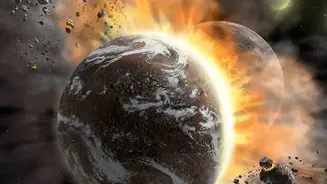
The transition to a white dwarf is violent. The star’s expansion and subsequent collapse wreaks havoc on any surviving planets and asteroids. The white dwarf’s immense gravity can rip apart these celestial bodies if they stray too close, shredding them into a disc of gas and dust. For years, astronomers have observed white dwarfs 'polluted' with heavy elements like calcium, iron, and magnesium. These elements should have sunk into the star's core long ago, so their presence in the atmosphere is a clear sign that the white dwarf is actively accreting, or feeding on, the debris of its old planetary system. This stellar graveyard, a disc of planetary remnants, was long thought to be the final chapter.
Phoenix from the Ashes
The latest discovery challenges that thinking. A team of astronomers, re-examining 25-year-old data from the Hubble Space Telescope, found something strange around a white dwarf named HS 0209+0832. Its atmosphere contained the usual planetary debris but also shockingly high levels of an element called niobium—more than 1,000 times the amount found in our Sun. Niobium is special because it's an element forged not in the normal life of a star, but during its death throes. Its presence is a 'signpost' of the material created inside the star and then ejected into space. This discovery suggests a radical idea: that this unique, element-rich debris didn't just stay as dust. Instead, it may have clumped together to form a brand new, 'second-generation' planet.
The Case for a New Planet
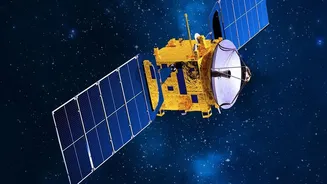
The evidence for this Jupiter-sized candidate planet is compelling, though it has not been directly seen. The strange chemical signature of niobium points to a body formed from the star's own remains, not a survivor from the original system. Furthermore, data from NASA's TESS satellite detected a regular dimming of the white dwarf's light every 4.4 days. This could be the signature of a large planet orbiting extremely close to the star, getting blasted by intense radiation and shedding its atmosphere like a comet. This lost atmosphere, containing niobium, is then captured by the white dwarf, which explains the unusual pollution. If confirmed, it would be the first time a second-generation planet has been found orbiting a white dwarf, a much more common stellar remnant than the pulsars where such planets have previously been theorised.
What This Means for the Cosmos
This discovery transforms our understanding of planetary systems. It suggests that a star's death isn't necessarily the end of the story, but perhaps just the end of the first chapter. The idea that planetary systems can be reborn opens up fascinating possibilities. It implies that even after our own Sun dies in about 5 billion years, destroying the inner planets, a new world could potentially form from its remnants. Lead researcher Jamie Williams noted that the find was 'completely unexpected'. The team believes the planet candidate is likely to survive its star's intense heat. As the white dwarf cools over millions of years, the planet could eventually find itself in a stable, habitable zone. This research changes the narrative from one of cosmic endings to one of cosmic renewal, suggesting that planetary systems can be far more resilient and dynamic than we ever imagined.