


A New Eye on Alien Skies
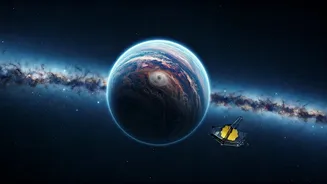
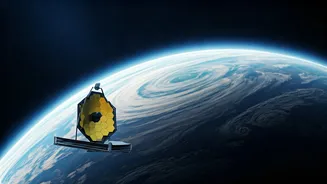
The game-changer in our cosmic search is NASA's James Webb Space Telescope (JWST). Launched as the successor to the Hubble Space Telescope, its power and precision are revealing details previously hidden from us. JWST is designed to see the universe in infrared
light, which is invisible to the human eye. This capability is crucial because it allows the telescope to cut through cosmic dust and analyse the chemical makeup of distant objects, including the atmospheres of planets orbiting other stars, known as exoplanets. Recent observations have provided a string of stunning breakthroughs, confirming the presence of key molecules in the air of these alien worlds.
How to Read the Air of a Distant World
So, how do scientists study the atmosphere of a planet that is hundreds of light-years away? The primary method is called transit spectroscopy. When an exoplanet passes in front of its host star from our point of view, a tiny fraction of the starlight filters through the planet's atmosphere. Different gas molecules absorb light at specific wavelengths, leaving a unique chemical fingerprint on the light that reaches the telescope. By analysing this filtered starlight, astronomers can identify the gases present, such as water vapour, methane, or carbon dioxide. Before JWST, these signals were often too faint or obscured to provide clear results, but its sensitivity is now consistently delivering detailed atmospheric profiles.
Case Study: The Hot Gas Giants
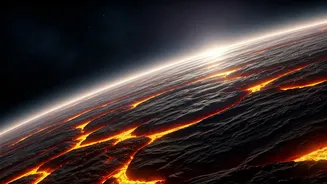
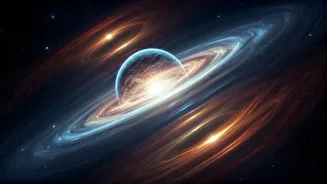
Many of the planets being studied are classified as 'hot Jupiters' or 'sub-Neptunes' — gas giants orbiting incredibly close to their stars. A prime example is WASP-18 b, an ultra-hot giant ten times more massive than Jupiter, located about 400 light-years away. Its atmosphere sizzles at temperatures around 2,700°C. Despite this intense heat, which would break apart many water molecules, JWST was sensitive enough to detect the subtle but clear signature of water vapour. Similarly, on another exotic world, TOI-421 b, JWST found a surprising mix of water vapour and other gases, challenging previous theories about how such planets form. These are not Earth-like worlds, but laboratories for understanding planetary chemistry.
Water Vapour, But Not as We Know It
It's crucial to understand what 'finding water' means in this context. This is not the discovery of swirling oceans, rain, or clouds that could support life. The water detected is in the form of gaseous water vapour, suspended in atmospheres that are often scorching hot and crushingly dense. On a planet like GJ 9827d, which is as hot as Venus, a water-rich atmosphere would create an inhospitable, steamy world. On WASP-107 b, a 'fluffy' exoplanet, water vapour exists alongside clouds made of fine sand particles. So while the presence of H2O is exciting, these particular exotic planets are not candidates for habitability. Their value lies in what they tell us about the building blocks of planets.
Why This Search Matters
Every detection of water vapour, even on the most bizarre and hostile exoplanets, is a monumental step forward. It confirms that the ingredients for life as we know it are not unique to our solar system but are common throughout the galaxy. By studying the atmospheres of these 'exotic' worlds, scientists can refine their models of planet formation and evolution. This knowledge helps them narrow down the search for smaller, rocky, and more temperate planets. Finding water on a hot Jupiter today brings us closer to knowing how to spot it on a potentially Earth-like world tomorrow, moving us one step closer to answering the ultimate question: are we alone in the universe?