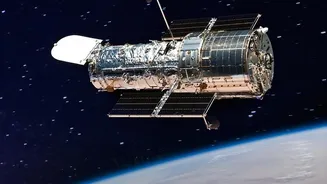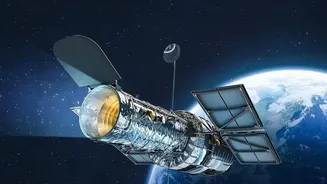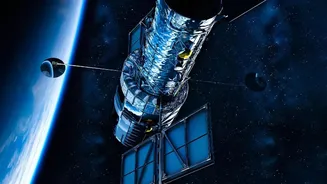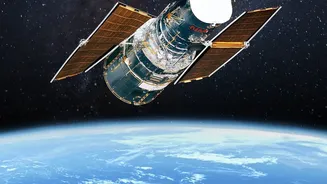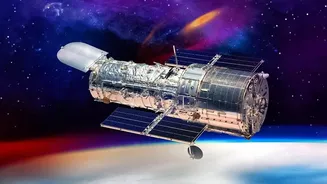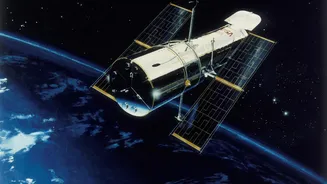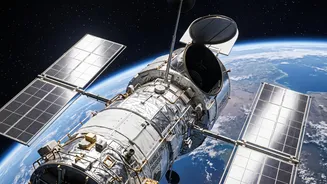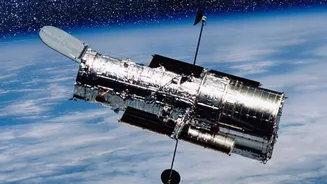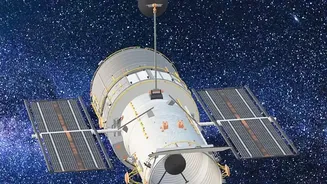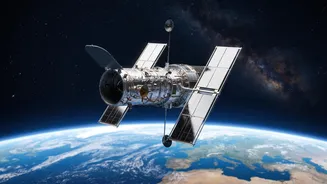




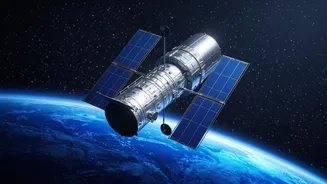
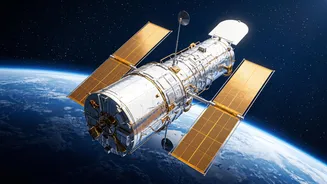
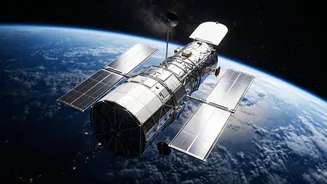
For over 35 years, the Hubble Space Telescope has been humanity's eye on the cosmos, but it is slowly falling back to Earth. Now, NASA is turning to the private sector in a landmark move to see if a commercial mission can save the iconic observatory.
A Legacy Facing a Slow Descent
Since its launch in 1990, the Hubble Space Telescope has made more than 1 million observations, leading to over 18,000 scientific papers and fundamentally changing our understanding of the universe. From proving the existence of black holes to measuring the age of the cosmos, its contributions are immeasurable. However, the legendary observatory has a problem: it has no engine. Flying through the thin upper traces of Earth's atmosphere creates a tiny amount of drag, and over decades, this has caused its orbit to decay. Without an intervention, NASA projects Hubble will make an uncontrolled reentry sometime between 2033 and 2034.
NASA's Call for Commercial Concepts
To address the problem, NASA took a significant step on October 29, 2026, by issuing a formal Request for Information (RFI). An RFI is not a contract; it is a way for the agency to survey the commercial marketplace and understand what technologies and mission ideas exist. This marks a major shift from the past, when Hubble was exclusively serviced by astronauts during Space Shuttle missions. The new RFI asks private companies for concepts on one of three possibilities: boosting Hubble to a more stable, higher orbit; servicing it with new components; or, as a last resort, guiding it to a safe, controlled deorbit over the ocean. Responses are due by November 30, 2026.
The Potential Players and Plans
This formal request follows a 2022 study NASA conducted with SpaceX and the Polaris Program, a private human spaceflight initiative funded by billionaire Jared Isaacman. That study explored the feasibility of using a SpaceX Dragon spacecraft to visit and reboost the telescope, potentially at no cost to the government. While that specific plan did not move forward, it demonstrated that a commercial mission was technically possible and helped pave the way for this broader inquiry. Now, the door is open to the entire industry. Companies like Northrop Grumman and Astroscale, which are developing robotic servicing vehicles, could also present solutions. The RFI asks potential providers to detail their launch vehicle, spacecraft, mission operations, and overall approach.
More Than a Boost: A New Business Model
The stakes are higher than just one telescope. A successful commercial mission to Hubble would effectively launch a new market for in-space servicing. It would create a template for how to extend the lives of other valuable but aging satellites, both government and commercial. As commercial space capabilities have evolved rapidly, NASA sees an opportunity to leverage private innovation in a cost-effective way. Nicky Fox, NASA's associate administrator for science, noted that the commercial industry has matured, offering new possibilities for capturing and servicing satellites. The RFI specifies that any rescue or boost mission would need to happen by 2032 to be effective, creating a sense of urgency.
What's Next for the Legendary Telescope?
For now, Hubble remains scientifically productive, continuing to provide unique observations in ultraviolet and visible light that its successors like the James Webb Space Telescope cannot. Once NASA reviews the RFI responses after the November 30 deadline, it will have a clearer picture of the viable options. The agency has not yet allocated any funding for a mission, so the ideas presented by private industry will need to be not only technically sound but also financially compelling. The decision will weigh the cost of a rescue against the immense scientific value Hubble could continue to provide for another 15 to 20 years if successfully boosted to a higher orbit.