



Why Your Plant's Roots Are at Risk
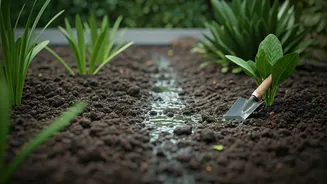
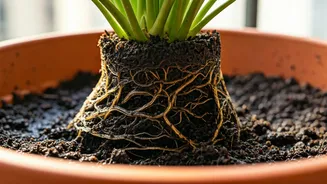
While the rains are a blessing, continuous downpours can saturate the soil, a condition known as waterlogging. For a plant's roots, this is an emergency. Roots need oxygen to function—they absorb it from small air pockets in the soil. When these pockets fill
with water, the roots effectively start to drown. This oxygen deprivation leads to root rot, a fungal disease that can quickly kill a plant from the ground up. Symptoms above ground, like yellowing leaves and wilting, are often late signs of a serious problem below. That's why protecting the root zone is the single most important task for a monsoon gardener.
Create a Drainage-Friendly Potting Mix
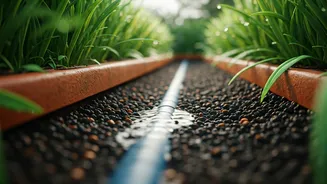
The foundation of root safety is the soil itself. Heavy, clay-like garden soil holds water for too long, creating a swampy environment in your pots. Before the monsoon arrives, consider repotting your plants in a lighter, more porous mix. A good formula is one part garden soil, one part compost for nutrients, and one part material for aeration. This third part is crucial. You can use coarse sand, perlite (small white volcanic rocks), or cocopeat (coconut husk fibre). These materials create larger air gaps, allowing excess water to drain away freely while still retaining enough moisture for the plant.
Elevate Your Pots and Check the Holes
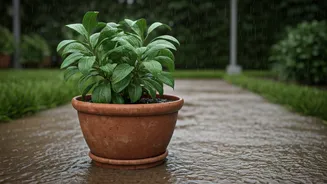
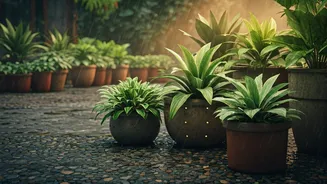
Even with the best soil, a pot sitting in a puddle of water will have problems. The simplest solution is to get your pots off the ground. Use pot stands, bricks, or 'pot feet' to lift them a few inches. This allows water to escape freely from the drainage hole and improves air circulation around the base. Speaking of drainage holes, now is the time to check them. Make sure they aren't blocked by compacted soil or roots. If a pot has only one small hole, you might even consider carefully drilling a few more around the base before the heavy rains begin. A clear exit path for water is non-negotiable.
Rethink Your Watering Schedule
It seems counterintuitive, but you shouldn't stop watering completely during the monsoon. Some plants, especially those under a covered balcony or patio, may not receive any rainwater at all. Others might be shielded by larger plants. The key is to abandon a fixed schedule and water only when necessary. The 'finger test' is your best friend: insert your finger about an inch into the soil. If it feels dry, it's time to water. If it feels moist or wet, leave it alone. Overwatering is the most common mistake, and during the monsoon, it's a mistake with severe consequences.
Prune for Better Air Circulation
A healthy plant is an ecosystem. What happens above ground affects what happens below. A dense, overgrown plant canopy traps humidity, creating a perfect breeding ground for fungal diseases like powdery mildew. These diseases can weaken the entire plant, making it more susceptible to root rot. Before the monsoon, give your plants a light pruning. Trim away any overcrowded branches, dead leaves, and stems that are touching the soil. This opens up the plant, allowing air to circulate freely and sunlight to penetrate deeper, which helps the leaves and the soil surface dry out faster after a shower.
Proactive Defence Against Fungi
Prevention is always better than cure, especially when it comes to fungal infections. Constant dampness makes your garden a paradise for harmful fungi. A simple, organic way to protect your plants is by spraying them with a neem oil solution every 10-15 days. Mix a few drops of neem oil with a gentle liquid soap and water. The soap helps the oil emulsify in the water. Spray this mixture on the leaves (both top and bottom) and stems. Neem oil acts as a natural fungicide and pest repellent, providing a protective layer that disrupts the life cycle of many common monsoon plant diseases.