

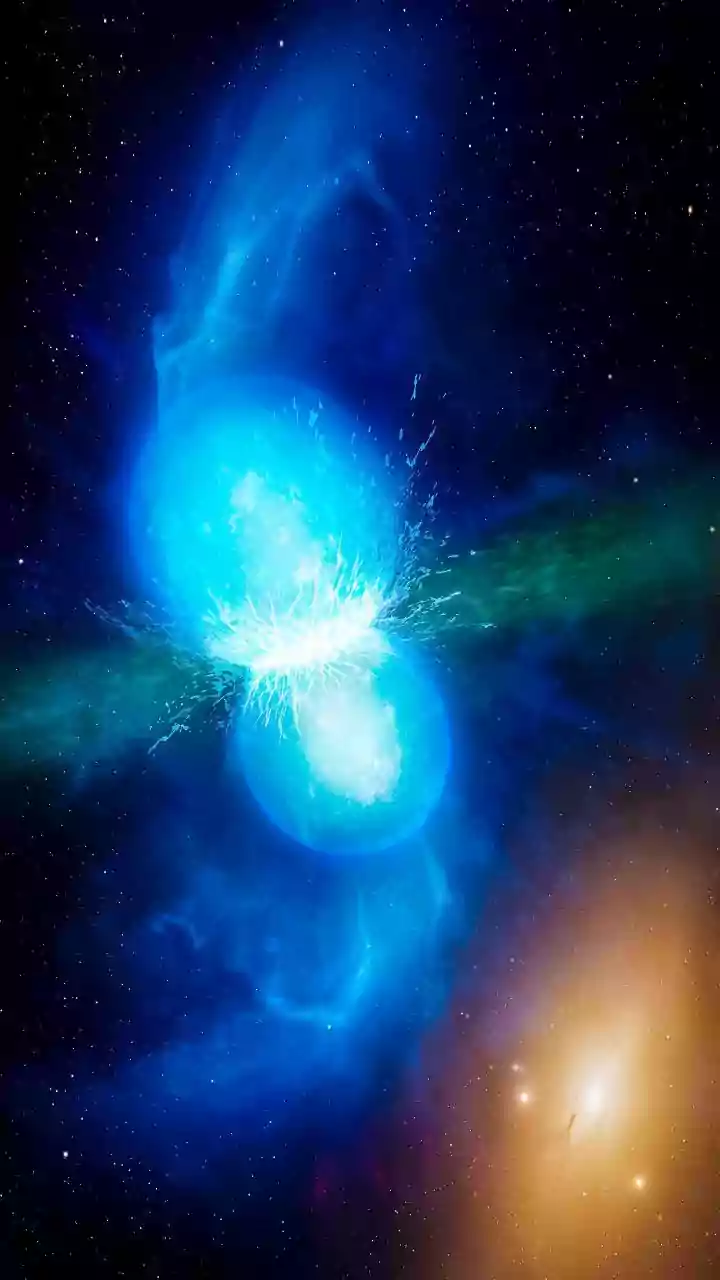

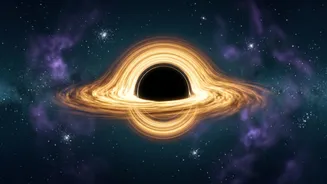
Imagine seeing a photograph of the universe when it was just a baby. That's what the Cosmic Microwave Background is: the oldest light, an echo of the Big Bang. Now, new tests of this ancient light are refining our cosmic origin story.
The Universe's Oldest Light
The Cosmic Microwave
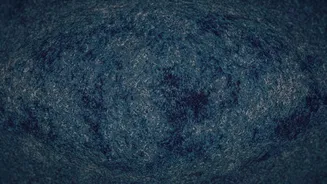
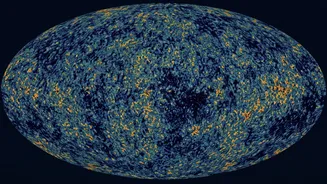
Background, or CMB, is often called the 'afterglow' of the Big Bang. It’s a faint, pervasive glow of radiation that fills the entire universe. This isn't light from stars or galaxies; it's much older. It dates back to about 380,000 years after the universe's birth, a time when the cosmos was a hot, dense, opaque fog of plasma. As the universe expanded and cooled, protons and electrons could finally combine to form neutral hydrogen atoms. This event, known as recombination, allowed light to travel freely for the first time. The universe became transparent, releasing a flash of light in all directions. For over 13 billion years, that light has been travelling, stretching with the expansion of space, and cooling to just 2.7 degrees above absolute zero. What started as visible light is now detected as faint microwaves, hence the name.
A Pillar of Modern Cosmology
The discovery of the CMB in 1965 was a landmark achievement, providing the strongest evidence for the Big Bang theory. The theory had predicted this remnant radiation, and finding it transformed our understanding of cosmic origins. But the CMB is more than just proof; it's a detailed map of the infant universe. While remarkably uniform, the CMB has minuscule temperature fluctuations—differences of just one part in 100,000. These tiny variations represent the 'seeds' from which all large-scale structures, like galaxies and galaxy clusters, would eventually grow. By studying these fluctuations, scientists can learn about the universe’s fundamental properties, including its composition (dark matter and dark energy), its geometry, and its history. It's like a cosmic time machine that offers clues to some of the biggest questions in physics.
The Latest Cosmic Check-Up
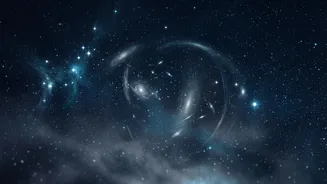
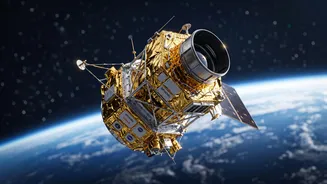
Scientists are constantly running new 'check-ups' on the CMB to test our standard model of cosmology. One of the most powerful new ways to do this involves an effect called gravitational lensing. As the CMB light travels across the universe, its path is slightly bent by the gravity of massive structures like galaxies and dark matter. A team of scientists using the South Pole Telescope recently analysed this lensing effect to create the sharpest and most sensitive map of all the matter between us and the early universe. By cataloguing how the ancient light has been warped, they can reconstruct a detailed map of the universe's mass distribution. This allows for incredibly precise tests of cosmological parameters, like how 'clumpy' or structured matter is across the cosmos.
What The New Maps Reveal
The recent analysis from the South Pole Telescope largely confirms the standard model of cosmology, known as the Lambda-CDM model. The observed clumpiness of matter in the universe aligns well with predictions made by this model, which is built upon our understanding of the Big Bang and the roles of dark matter and dark energy. However, other recent studies of the CMB's polarization—the orientation of the light waves—have hinted at potential cracks in this standard model. Some research suggests a slight, unexpected rotation in the light's polarization, a phenomenon called 'cosmic birefringence'. While not yet conclusive, if this finding is confirmed, it could mean that our basic assumptions about the universe being the same in all directions (homogeneity) might be subtly wrong, potentially pointing toward new physics.
Why These Tests Matter
Each new test of the Cosmic Microwave Background pushes the boundaries of our knowledge. Confirming the standard model, as the South Pole Telescope data does, strengthens our confidence in the story of our universe. It validates our theories about how structures formed and how the cosmos evolved over 13.8 billion years. At any time there are intriguing anomalies like potential for cosmic birefringence are just as exciting if not more so these discrepancies are what drive science forward forcing us to question our assumptions and search for deeper explanations Furthermore these precise CMB measurements offer unique ways to probe other cosmic mysteries such as mass of elusive neutrino particle which left its own subtle imprint on growth of cosmic structure Each map brings us one step closer to complete picture of our cosmic origins.