






A Celestial Meet-Up Explained
In astronomy, when two celestial objects appear close to each other in the sky from our perspective on Earth, it’s called a conjunction. The Moon, in its monthly orbit around our planet, frequently passes by the planets in our solar system. This October
alignment sees the Moon glide near Saturn, the famous ringed planet. While they look like close neighbours during this event, it's a beautiful illusion of perspective. In reality, Saturn is thousands of times farther away from us than the Moon is. The alignment happens because Earth, the Moon, and Saturn fall into a similar line of sight, creating a striking visual pairing for us on the ground.
The Moon as a Cosmic Signpost
One of the simplest reasons this alignment is so great for sky-gazers is that the Moon acts as a giant, glowing guide. While Saturn is visible to the naked eye, it can be tricky to distinguish from the countless stars twinkling in the night sky. However, when the bright and unmistakable Moon is positioned right next to it, finding Saturn becomes incredibly easy. You don't need a star chart or a special app; you just need to find the Moon and look for the bright, non-twinkling 'star' nearby. This makes the event highly accessible, even for those who are new to astronomy. The Moon essentially points out one of the solar system's greatest treasures.
The Sheer Allure of the Ringed Planet
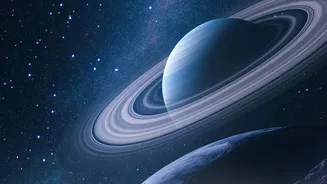
Saturn itself is the main event. It’s the planet that inspires the most awe when seen through a telescope for the first time, purely because of its magnificent rings. While you need a telescope or a good pair of binoculars to see the rings, their presence makes the conjunction magical. Even a small telescope will reveal the rings as a distinct structure separate from the planet. During October, Saturn is often near 'opposition', the point in its orbit where it is closest and brightest to Earth for the year. This year, for instance, Saturn's opposition is on October 4, 2026, making it appear particularly bright around this time. This enhanced brightness, combined with its steady, golden hue, makes Saturn a stunning partner for our silvery Moon.
A Glimpse of the Rings in 2026
The appearance of Saturn's rings changes over its 30-year orbit around the Sun. In 2025, Earth passed through Saturn's ring plane, causing the rings to become nearly invisible as we saw them edge-on. By October 2026, the rings will have tilted back into view, though they will still appear as a thin, bright line. The ring system will be tilted about 7.5 degrees relative to Earth, which is enough to make them easily visible and beautiful through a telescope. Seeing that delicate, glowing slash next to the familiar, cratered face of our Moon is a truly memorable sight, reminding us of the vast and dynamic nature of our solar system.
How to Best Experience the View
To get the most out of this celestial show, it’s best to find a location away from bright city lights, which can wash out the sky. While you can spot the pairing with your naked eye from a city, darker skies will reveal more detail and make the experience richer. Give your eyes about 20 minutes to adjust to the darkness. If you have binoculars, they will enhance Saturn's golden colour and might even show it as a slightly elongated disc. For a view of the rings, a small telescope with at least 25x to 50x magnification is needed. Look for the alignment in the evening sky; check local astronomy resources for the exact time the Moon and Saturn will be at their closest.