



Cosmic Lighthouses
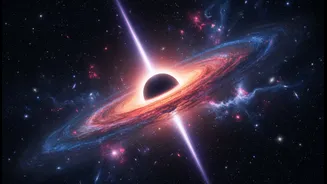
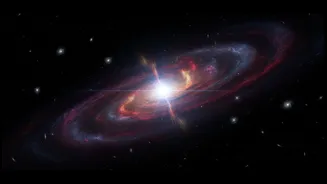
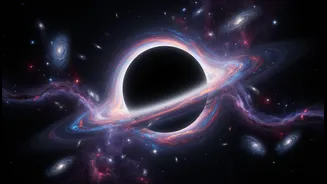
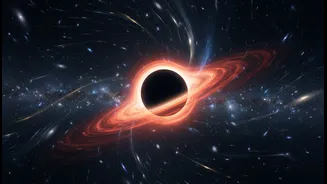
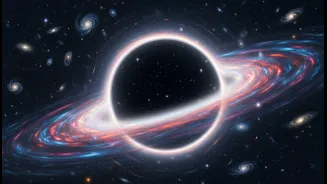
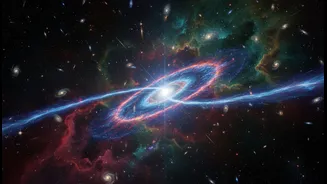
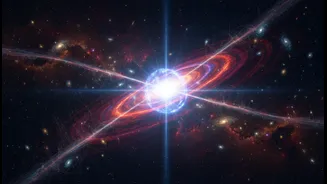
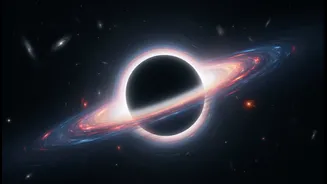
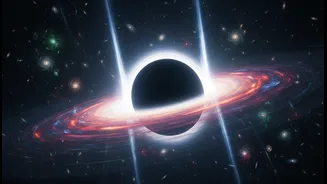
So, what exactly is a quasar? It's the intensely bright core of a distant galaxy, powered by a supermassive black hole millions or even billions of times the mass of our Sun. As the black hole pulls in surrounding gas and dust, it unleashes a torrent
of energy and radiation, creating a beacon that can outshine all the stars in its host galaxy combined. Because they are so luminous, we can detect quasars from across the universe, allowing us to look back in time to when the cosmos was in its infancy, just a few hundred million years after the Big Bang.
Peering Through the Fog
For hundreds of millions of years after the Big Bang, the universe was filled with a thick, neutral hydrogen gas that acted like a cosmic fog, making it opaque to energetic light. This period is known as the cosmic 'dark ages.' Eventually, the first stars and galaxies began to form, and their collective radiation started to ionize the surrounding gas—stripping electrons from the hydrogen atoms. This transformed the universe from a neutral, opaque state to the ionized, transparent one we know today. This transformative period is called the Epoch of Reionization, and understanding it is key to understanding how the first galaxies were born.
Reading a Cosmic Barcode
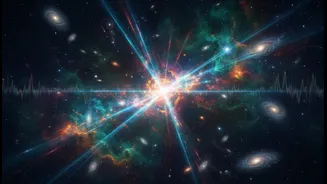
This is where quasars come in. Astronomers use them as powerful backlights to study the vast, otherwise invisible material lying between the quasar and us. As a quasar's light travels for billions of years across the cosmos, it passes through clouds of intergalactic gas. This gas absorbs the light at very specific frequencies, leaving a unique pattern of dark lines in the quasar's spectrum—like a cosmic barcode. By analyzing this 'barcode,' known as the Lyman-alpha forest, scientists can determine the composition, density, and temperature of the gas clouds the light passed through.
Mapping the Invisible Web
This technique has revealed that the matter in the early universe wasn't a uniform fog, but was instead arranged in a vast, filamentary structure called the 'cosmic web.' These immense ropes of gas and dark matter spanned the cosmos, with galaxies forming at their densest intersections. By using the light from numerous quasars, astronomers can create 3D maps of this ancient cosmic architecture, revealing the skeleton of the universe and how the very first galaxies were fed by these enormous gas filaments. Advanced instruments like the James Webb Space Telescope (JWST) are now providing unprecedented detail, showing the chaotic nature of these early, star-forming galaxies.
Solving Primordial Puzzles
This method is already solving long-standing mysteries while uncovering new ones. Recent observations from the JWST have helped confirm that it was the light from early galaxies that drove the Epoch of Reionization, clearing the cosmic fog. However, the telescope has also found ancient quasars that appear surprisingly isolated, challenging theories about how their supermassive black holes could have grown so large, so quickly without a dense environment to feed on. Each new observation provides another crucial piece of the puzzle, helping scientists refine their models of how our universe became the star-filled cosmos we see today.