



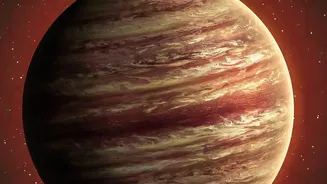


A Whisper of Water Across Light-Years
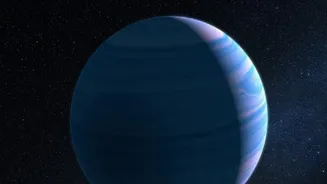
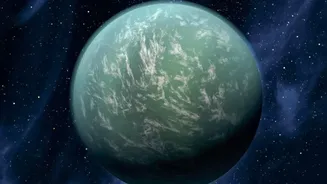
Scientists have confirmed the presence of water vapour in the atmosphere of GJ 1214 b, a planet classified as a 'mini-Neptune' or 'super-Earth' located about 48 light-years away. While that sounds distant, in cosmic terms, it's a relatively close neighbour.
For years, this planet has been a source of mystery for astronomers because its atmosphere is shrouded in a thick layer of clouds or haze, making it difficult to study. But the powerful infrared instruments of the James Webb Space Telescope (JWST) have finally pierced through that veil, giving us our clearest view yet of this enigmatic world. The detection doesn't just confirm water is present, but it also suggests that the atmosphere is primarily made of heavier molecules, like water or methane, rather than light hydrogen.
How Webb Reads an Alien Atmosphere
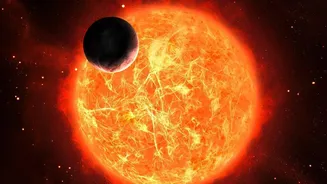
The technique used is called transit spectroscopy, and it's an ingenious way of analysing a planet's air from trillions of kilometres away. It works by observing a planet as it passes in front of its host star from our point of view. As the starlight filters through the edge of the planet's atmosphere, different molecules absorb specific colours, or wavelengths, of light. These missing slivers of light leave a unique chemical fingerprint in the spectrum that the telescope collects. For GJ 1214 b, JWST's Near-Infrared Spectrograph (NIRSpec) captured the tell-tale signature of water molecules absorbing the starlight, confirming its presence in the hazy atmosphere. This method is so sensitive it can give us clues about a planet's composition, temperature, and cloud cover.
Meet the Steamy Super-Earth
GJ 1214 b is unlike any planet in our own solar system. It's about 2.7 times the size of Earth but orbits its small red dwarf star in just 1.6 days. This tight orbit means the planet is scorching hot, with temperatures shifting from about 279°C on its permanent dayside to 165°C on its nightside. Because of this heat, it's not a place where you'd find liquid water oceans. Instead, astronomers believe it could be a 'water world', where a significant portion of the planet's mass is water. The intense heat would have turned any surface water into a thick, steamy atmosphere, blanketing the entire planet. Scientists theorise it may have formed farther from its star and migrated inwards, boiling its icy and liquid water into the dense vapour envelope we see today.
Water Doesn't Automatically Mean Life
Finding water, a key ingredient for life as we know it, is always exciting. However, it's crucial to put this discovery in context. The water on GJ 1214 b is in the form of incredibly hot steam in a dense atmosphere, not life-sustaining liquid oceans. The planet's extreme temperatures make it uninhabitable by our standards. So while this isn't the discovery of an Earth-like paradise, it is a hugely important proof of concept. It demonstrates that the JWST has the power to detect the building blocks of habitability on distant rocky worlds, even those with challenging, cloudy atmospheres.
A New Era in the Search for Habitable Worlds
The findings for GJ 1214 b are a turning point. For over a decade, this planet's atmosphere was a closed book, but the JWST has opened it. This success provides a clear roadmap for future observations. The same techniques can now be applied to other, more temperate rocky planets that orbit within their star's 'habitable zone'—the region where liquid water could potentially exist on a planet's surface. Each discovery like this sharpens our understanding of how planets form and what their atmospheres are made of. It refines the list of targets for follow-up studies and brings us one step closer to answering the ultimate question: are we alone in the universe?