





The AI Brain in Orbit
The first piece of this high-tech puzzle is Artificial Intelligence (AI). For decades, satellites have largely acted as orbital cameras and relays, capturing vast amounts of data and sending it back to Earth for processing. This creates a significant
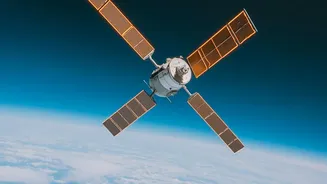
time lag. Experts at the Indian Space Research Organisation (ISRO) have highlighted that integrating AI and machine learning will fundamentally change this model. Future satellites will be able to process data directly in orbit, a concept known as on-board processing or edge computing. Instead of just transmitting raw images of a flood zone, for instance, an AI-equipped satellite could analyze the data on the spot, identify the most critical areas of damage, and send back an actionable, pre-analyzed report. This capability for real-time decision-making would be transformative for disaster management, urban planning, and national security surveillance. India has already deployed AI in missions like its Chandrayaan lunar landers for navigation and is developing it for everything from spacecraft health monitoring to big data analytics.
Seeing More with Advanced Sensors
A smarter satellite is only as good as what it can perceive. To that end, India is also making significant strides in developing advanced sensors. ISRO has become a global leader in radar systems, with capabilities spanning most major frequency bands. This expertise was central to the development of the NASA-ISRO Synthetic Aperture Radar (NISAR) mission, one of the most advanced radar satellites ever built. The NISAR satellite, a joint U.S.-India project, can detect changes in the Earth's surface smaller than a quarter of an inch, offering unprecedented detail for monitoring everything from earthquakes and volcanic activity to melting ice sheets. Future Indian satellites will build on this foundation, incorporating a new generation of sensors. These could include highly sensitive magnetometers and atomic clocks developed under India's National Quantum Mission, which are designed for incredibly precise timing and navigation. This allows for not just seeing the planet in new ways but also navigating and positioning with a degree of accuracy that was previously unattainable.
The Quantum Leap for Security
Perhaps the most groundbreaking element of India's vision is the integration of quantum technology. Its primary application in space is for ultra-secure communication. Traditional encryption methods can, in theory, be broken by powerful computers. Quantum Key Distribution (QKD), however, uses the principles of quantum physics to create theoretically unhackable communication channels. Any attempt to intercept a quantum-secured message would disturb the quantum state of the photons, immediately alerting the sender and receiver. In March 2021, ISRO successfully demonstrated free-space Quantum Communication over a distance of 300 meters, a milestone achievement for the country. The goal is to extend this capability to space. India's National Quantum Mission, approved in April 2023 with a budget of over $700 million, explicitly aims to demonstrate satellite-based secure quantum communications over 2,000 kilometers. This would create a powerful shield for military communications, financial transactions, and other sensitive data transmitted via satellite.
Why Combining Them Is a Game Changer
Individually, these three technologies are powerful. But their convergence is what creates a truly next-generation capability. An Indian satellite of the future could use its advanced sensors to gather high-resolution data on troop movements near a border. The onboard AI could instantly analyze this data, differentiate between routine patrols and unusual activity, and flag it as a potential threat. Then, using a QKD link, it could transmit this critical, time-sensitive intelligence back to defense agencies on the ground with virtually no risk of interception. This synergy—seeing everything, understanding it instantly, and communicating it securely—represents a significant strategic advantage. It enhances India's capacity for geo-intelligence gathering, with the country aiming to launch 50 such satellites over the next five years. This network would strengthen everything from defense frameworks to disaster response, placing India in an elite group of nations with such integrated space capabilities.