



The Treasure in the Shadows
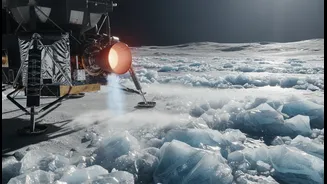
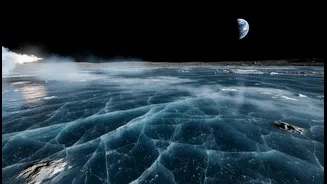
For decades, scientists have theorized about water ice hiding in the Moon's permanently shadowed regions (PSRs) near the poles. These are some of the coldest places in the solar system, where sunlight has not reached for potentially billions of years.
This makes them perfect cold traps, preserving a priceless scientific record. This ice isn't just frozen water; it's a potential time capsule containing clues to the formation of our solar system and perhaps even the origins of life on Earth. For future explorers under programs like Artemis, this ice also represents a critical resource. It can be harvested for drinking water, split into breathable oxygen, and processed into hydrogen and oxygen for rocket fuel, dramatically reducing the cost of deep-space travel.
An Invisible, Global Problem
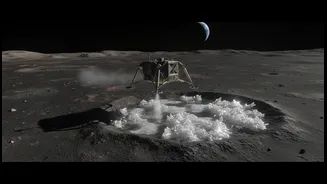
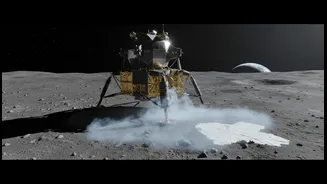
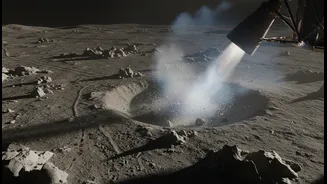
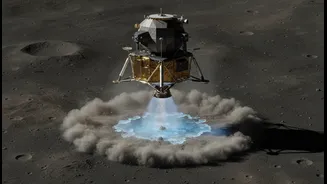
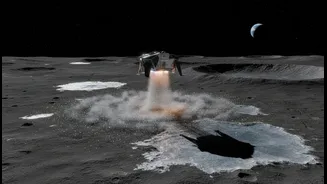
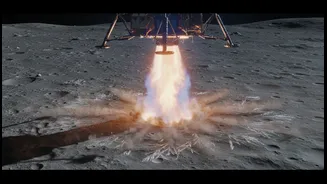
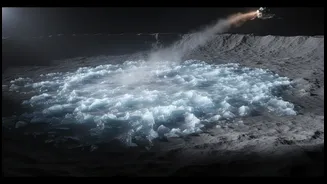
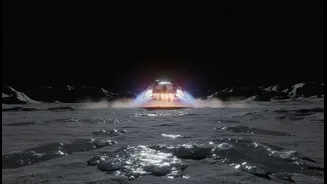
The problem arises from the physics of landing a spacecraft in a near-vacuum. Powerful rocket engines are needed to slow a lander's descent. This process kicks up clouds of abrasive lunar dust and, more importantly, releases enormous quantities of exhaust gases. Key components of this exhaust, depending on the fuel, include water vapor, carbon dioxide, and methane. On Earth, an atmosphere would contain this plume. But on the Moon, the lack of an atmosphere means these exhaust molecules expand rapidly and globally. Computer simulations have shown that exhaust from a single landing near the south pole can spread around the entire Moon in just a few hours.
A Race Against Our Own Footprints
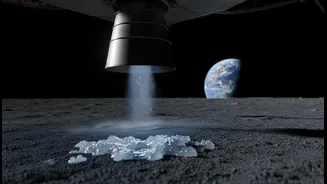
This exhaust doesn't just dissipate. A significant portion eventually settles and freezes in the same permanently shadowed regions that hold the ancient, pristine ice. Studies show that within months, 30% to 40% of the water vapor from a lander's exhaust could persist, with a substantial fraction migrating to the poles. Recent research published in 2026 highlights the threat from methane, a key component in the exhaust of newer landers. Over half of the methane released could become trapped at the poles, potentially coating the native ice and confounding scientific measurements. This creates a fundamental conflict: the first powerful landers of the Artemis era could contaminate the scientific record for all subsequent, more sensitive missions designed to study it. The contamination could mask or alter the very chemical signatures scientists hope to find.
The Scale of the Challenge
The contamination isn't a minor, localized issue. The affected area is considerably larger than the visible "blast zone" created by a landing. One study simulated a mid-sized lander—only about a quarter of the mass of an Apollo Lunar Module—and found its exhaust had global reach. With NASA and its commercial partners planning to use much larger landers, like SpaceX's Starship, the amount of exhaust and potential contamination will scale up significantly. This has led some scientists to call for careful planning and even a potential moratorium on entering some of the most sensitive PSRs until the risk is better understood. As one European Space Agency official put it, "Our activity can actually hinder scientific exploration."
The Search for Cleaner Solutions
Recognizing the threat, mission planners and scientists are exploring ways to mitigate the damage. One obvious strategy is to land farther away from the most sensitive craters, though studies show contaminants can travel across the entire lunar surface. Other ideas include using smaller, specialized robotic missions to scout and sample these regions first, before the arrival of heavy crewed landers. Documenting the isotopic composition of propellants before launch would help scientists distinguish between exhaust and native materials later on. More advanced concepts involve developing landing pads on the Moon to help contain the plume or designing new engine configurations that minimize its spread. The consensus is that modeling and monitoring exhaust gases must become a routine part of lunar mission planning.