






A Marathon of Milestones
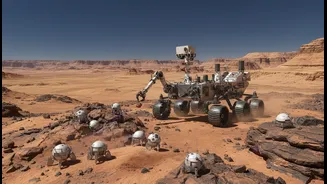
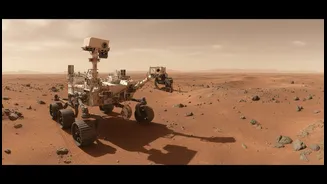
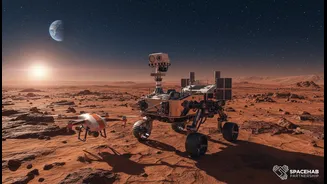
In mid-June 2026, after five years and four months of navigating the treacherous terrain of Jezero Crater, the Perseverance rover officially travelled the distance of a full marathon. This feat was accomplished in less than half the time it took its predecessor,
the Opportunity rover, highlighting a giant leap in autonomous navigation technology. While Opportunity often had to wait for daily instructions from Earth, Perseverance's advanced AutoNav system allows it to think for itself, calculating routes and avoiding hazards in real-time. This capability is crucial, as it enables the rover to cover more ground and conduct more science, transforming it from a remote-controlled vehicle into a truly robotic field geologist millions of kilometres away.
More Than a Driver, It’s a Scientist
Perseverance’s primary mission is to search for signs of ancient microbial life. The rover is equipped with a suite of sophisticated instruments to analyze rocks on the spot. Instruments like PIXL (Planetary Instrument for X-ray Lithochemistry) and SHERLOC (Scanning Habitable Environments with Raman & Luminescence for Organics & Chemicals) allow it to examine the texture and chemical composition of rocks at a near-microscopic scale. Its most vital task, however, is to drill and cache samples. To date, it has collected a diverse set of pristine rock and soil samples, sealing them in titanium tubes. These tubes are the first step in one of the most ambitious undertakings in space history: bringing pieces of Mars back to Earth.
Paving the Way for Human Explorers
Beyond its geological work, Perseverance is a critical testbed for technologies that will one day support human missions. The most notable of these is the Mars Oxygen In-Situ Resource Utilization Experiment, or MOXIE. This car-battery-sized device has successfully and repeatedly produced breathable oxygen from the thin, carbon dioxide-rich Martian atmosphere. Over several years of experiments, MOXIE proved that future astronauts could potentially generate their own oxygen for life support and, crucially, to create the propellant needed for the rocket journey home. This moves the idea of a human outpost on Mars from the realm of science fiction closer to engineering reality.
An Unexpected Plot Twist
The core samples collected by Perseverance are currently sitting on the Martian surface, waiting for a ride home that has become uncertain. The ambitious Mars Sample Return (MSR) mission, a joint NASA and European Space Agency (ESA) project, was designed to send a lander and a small rocket to retrieve these precious samples. However, due to ballooning costs and schedule delays, the original plan was effectively cancelled in early 2026. NASA is now scrambling to develop a new, faster, and cheaper alternative, with a final decision on the new architecture expected later this year. This highlights the immense logistical and financial challenges of interplanetary science, but the scientific community remains adamant that retrieving these samples is one of the highest priorities for understanding Mars and the potential for life beyond Earth.
The Global Robotic Frontier
While NASA re-evaluates its sample return strategy, the robotic exploration of the solar system continues to accelerate globally. The European Space Agency is moving forward with its Rosalind Franklin rover, planned for a 2028 launch, which will use a two-metre drill to search for life protected beneath the harsh Martian surface. China is also developing its own Mars sample return mission. Critically for India, this global endeavour includes ISRO's own ambitious plans. Following the success of the Mars Orbiter Mission (Mangalyaan), ISRO is developing Mangalyaan-2, which is expected to include a lander and rover. Alongside a planned Venus orbiter mission and a lunar sample return mission, India is positioning itself as a key player in the next generation of planetary exploration.