

The High Cost of Cosmic Cartography
To understand the universe, especially mysterious forces like dark energy that drive its accelerating expansion, scientists need a map. Traditionally, creating this map involves painstaking galaxy surveys. Telescopes spend immense amounts of time staring
at tiny patches of sky, identifying individual galaxies, measuring their light, and calculating their distance. This process is incredibly effective but also astronomically expensive, requiring many millions of dollars and significant resources. These surveys are also limited, as they can only focus on parts of the universe where matter is hot and dense enough to have formed bright stars and galaxies. This leaves vast, darker regions of the cosmic web largely un-charted, providing an incomplete picture.
Introducing CHIME: The Universe's Skateboard Ramp
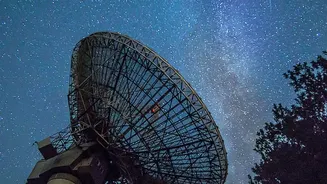
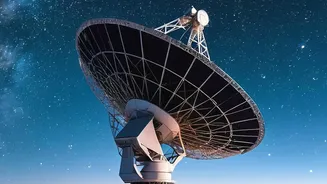
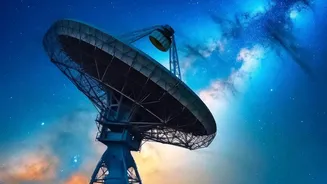
Enter the Canadian Hydrogen Intensity Mapping Experiment, or CHIME. Located in British Columbia, it looks less like a conventional telescope and more like four giant snowboarding half-pipes made of wire mesh. Unlike steerable dishes, CHIME has no moving parts. It simply stares straight up, using the Earth's rotation to scan the entire northern sky every single day. Its power comes from a massive supercomputer that processes a flood of data comparable to the world's entire mobile network traffic. Instead of looking for starlight, CHIME listens for a much fainter, more widespread signal: the radio waves emitted by neutral hydrogen gas, the most abundant element in the cosmos.
A New Way of Seeing: Hydrogen Intensity Mapping
The breakthrough technique is called 'hydrogen intensity mapping'. Instead of trying to spot individual, distant galaxies (like picking out single trees in a faraway forest), CHIME measures the combined radio glow from huge volumes of space. It detects the faint radiation from vast clouds of hydrogen gas, which acts as a tracer, revealing the underlying structure of the universe. Variations in the brightness of this signal show where matter is more or less clustered. This approach sacrifices the fine detail of galaxy surveys for immense speed and scale, allowing scientists to create a 3D map of the universe much more efficiently and at a fraction of the cost.
A Standalone Success
In a milestone achievement announced in late 2026, the CHIME collaboration revealed it had successfully detected the structure of the universe from 8.5 billion years ago using this technique—without relying on data from other telescopes. Previously, CHIME had to cross-reference its findings with traditional, expensive galaxy surveys to confirm its results. By making a standalone detection, a process called auto-correlation, the team proved the method works on its own. This is a crucial proof-of-concept, demonstrating that hydrogen intensity mapping is a robust and independent tool for cosmology. The detection opens the door for CHIME to map the cosmic expansion history and probe the nature of dark energy on its own terms.
What This Means for the Future of Cosmology
This new method could fundamentally change the business of cosmology. By reducing the reliance on costly galaxy-by-galaxy surveys, it democratizes the study of the large-scale universe. Scientists can now probe farther back in time and across larger swaths of the sky more rapidly than ever before. The primary goal is to measure something called Baryon Acoustic Oscillations (BAO), which are like cosmic yardsticks left over from the Big Bang. Tracking how the apparent size of these 'yardsticks' changes over cosmic time allows scientists to precisely measure the universe's expansion history. This, in turn, provides one of the most powerful ways to test theories about dark energy, the biggest puzzle in modern physics. CHIME's success represents a bold new step in that quest.