




The Cosmic Speed Limit
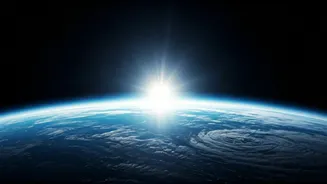
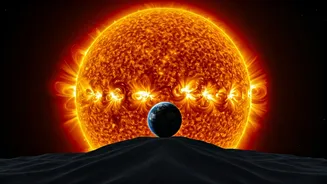
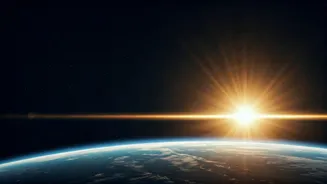
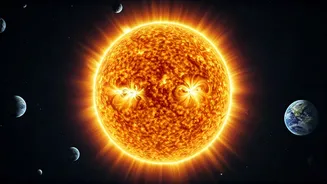
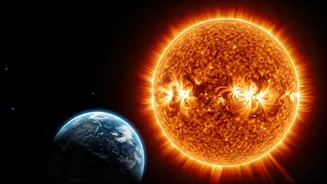
The simple fact is that the sun is very, very far away—about 150 million kilometres on average. And while light is the fastest thing in the universe, it isn't instantaneous. It travels at a staggering speed of nearly 300,000 kilometres per second. When
you do the maths (dividing the distance by the speed), you get a travel time of about 500 seconds. Convert that to minutes, and you land on approximately 8 minutes and 20 seconds. So, every ray of sunlight you experience is technically over eight minutes old. It’s a direct message from the past, delivered at the cosmic speed limit.
A Glimpse of the Past
This eight-minute delay has a profound and slightly unsettling implication. If, hypothetically, the sun were to suddenly vanish or be switched off like a light bulb, we on Earth wouldn't know it for eight minutes and 20 seconds. For that duration, our skies would remain bright, the world would seem normal, and we'd be completely oblivious to the catastrophic event that had already occurred. This time lag isn't unique to the sun. It applies to everything we see in space. The light from the nearest star system, Alpha Centauri, is over four years old. The light from the Andromeda Galaxy? A staggering 2.5 million years old. When we look up at the night sky, we are quite literally looking back in time.
The Real Journey Begins
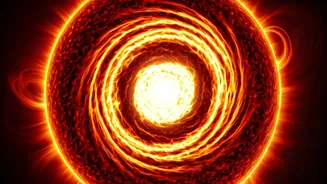
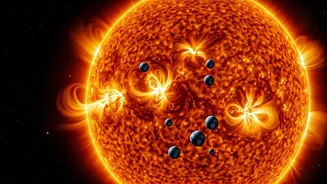
But the eight-minute trip through space is just the final, short sprint of a much, much longer journey. The story of a particle of light, a photon, actually begins deep within the sun's core. Here, under immense pressure and at temperatures of 15 million degrees Celsius, hydrogen atoms fuse together to create helium, releasing a burst of energy in the form of a photon. You might think this newly born photon zips straight out, but it doesn’t. The sun's interior is incredibly dense, packed with a plasma of charged particles. Our brand-new photon immediately collides with an atom, gets absorbed, and is re-emitted in a random direction. It then travels a tiny distance before hitting another particle, and another, and another.
A Million-Year Random Walk
This process is called a 'random walk'. The photon is not moving in a straight line but staggering around like a lost traveller in a massive, dense crowd. Because of these countless collisions, absorption, and re-emission events, it can take a single photon anywhere from 10,000 to several million years to make its way from the sun’s core to its surface. Think about that: the light hitting your face today may have been created before human civilization even began. After that incredibly long and chaotic journey, it finally escapes the sun’s surface and embarks on its final, uninterrupted eight-minute flight to Earth.
An Appreciation of Scale
Understanding this two-part journey—the ancient, chaotic crawl inside the sun and the final, swift dash through space—gives us a new appreciation for our star. The sunlight we often take for granted is the end product of an epic process spanning cosmic timescales and vast distances. It highlights the immense scale of our solar system and the universe. That simple eight-minute delay is a constant reminder that we are part of a dynamic and enormous cosmic system, where even the fastest thing in existence needs time to travel.