






What Is the Summer Solstice?
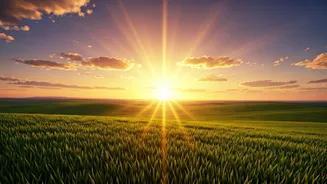
In simple terms, the summer solstice is the exact moment when the sun reaches its highest and northernmost point in the sky. For everyone living in the Northern Hemisphere, including all of India, this event marks the official start of astronomical summer.
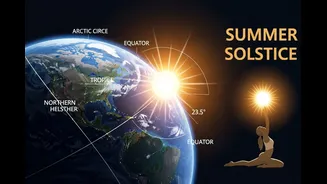
It's the day with the longest period of daylight and, consequently, the shortest night. The word 'solstice' itself comes from the Latin 'sol' (sun) and 'stitium' (to stand still), because on this day, the sun appears to briefly pause its northward movement in the sky before reversing its course. From June 22 onwards, the days will slowly but surely start getting shorter as we move towards the winter solstice in December.
It's All About the Tilt
The reason for seasons and the length of our days isn't about Earth's distance from the sun—in fact, the Earth is actually near its farthest point from the sun in early July. The real reason is our planet's axial tilt. Earth is tilted on its axis by approximately 23.5 degrees. Think of it like a spinning top that isn’t perfectly upright. As Earth makes its year-long journey around the sun, this tilt means that different parts of the planet receive the sun’s rays more directly at different times. During the June solstice, the Northern Hemisphere is tilted most directly towards the sun. This orientation means the sun's path across our sky is at its longest and highest, providing us with the maximum number of daylight hours.
Maximum Sunlight Across India
While June 21 will be the longest day of the year for the entire country, the exact amount of daylight you experience will depend on your location. Cities further north will see a slightly longer day than those in the south. For example, Delhi and Chandigarh will experience a day length of nearly 14 hours, while cities like Mumbai will have around 13 hours and 15 minutes of daylight. In Chennai, further south, the day will last just under 13 hours. This variation is due to the curve of the Earth. The further north you are from the equator on the summer solstice, the longer the sun remains visible above the horizon. Regardless of the exact duration, the entire nation will enjoy the peak of solar light for the year.
A Day of Cultural and Spiritual Significance
The summer solstice has been a cornerstone of cultures and civilizations for millennia. Ancient monuments like Stonehenge in the UK and the Pyramids in Egypt are aligned with the sun's position on the solstices. In India, the day has a profound modern and ancient significance, most notably as the International Day of Yoga. In 2014, India successfully led the initiative at the United Nations to declare June 21 as the global day for yoga. The date was chosen specifically because the summer solstice is a day of maximum light, symbolizing a transition and a powerful time for spiritual practices. In yogic lore, the summer solstice is traditionally seen as the day when Adiyogi, the first yogi, turned south to face the Saptarishis (the seven great sages) and began imparting the knowledge of yoga to humanity, becoming the first Guru (Adi Guru).
Simple Ways to Mark the Occasion
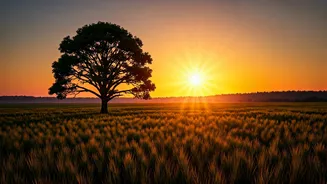
You don't need to be an astronomer or a yogi to appreciate the longest day of the year. Here are a few simple ways to mark the occasion: 1. **Watch the Sunrise:** Start the longest day by witnessing its very first moments. It’s a peaceful way to connect with the day’s special significance. 2. **Join a Yoga Session:** With events happening in parks, public squares, and studios across the country, participating in a yoga session is a perfect way to honour the day’s spirit. 3. **Enjoy the Late Sunset:** Take advantage of the extra daylight. Plan an evening walk, have dinner outdoors, or simply take a moment to notice how late the light lingers in the sky. 4. **Connect with Nature:** The solstice marks a peak of solar energy. Spending time in a garden or park can be a grounding way to acknowledge this natural milestone and the changing of the seasons.