
1992 World Cup: A Cruel Rain Delay
South Africa’s first World Cup campaign after readmission was a fairytale run that ended in a farce. In the semi-final against England, they were cruising, needing a gettable 22 runs from 13 balls. Then, the rain came down in Sydney. What followed was a calamitous
application of the tournament's rain rule, which absurdly recalculated the target. When play resumed after just a 12-minute delay, the scoreboard showed an impossible equation: 21 runs needed off a single ball. It was a baffling and cruel end for a team that had captured the world's imagination, marking the start of a long and painful history with knockout games.
1999 World Cup: The Ultimate 'Choke'
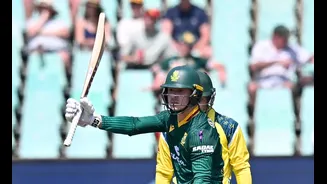
This is the match that defines South African cricket’s tragic narrative. In the semi-final against Australia, the game ebbed and flowed before landing in the hands of Lance Klusener, the tournament's destructive hero. Needing nine runs from the final over, Klusener smashed the first two balls for four, levelling the scores. One run was needed from four balls to reach their first-ever final. What followed was chaos. A mix-up, a desperate scramble, and a run-out involving Klusener and Allan Donald meant the match ended in a tie. Australia advanced to the final due to a superior group stage finish, leaving a nation stunned and coining the most infamous 'choke' in cricket history.
2003 World Cup: A Miscalculation on Home Soil
Hosting the World Cup for the first time, the Proteas faced a must-win group game against Sri Lanka in Durban. With rain threatening, the Duckworth-Lewis (D/L) method came into play. The message sent out to the batsmen, Mark Boucher and Lance Klusener, was that 229 was the target to reach by the end of the 45th over. Boucher hit a six to take the score to 229 and then blocked the final ball of the over, celebrating as he thought the job was done. Tragically, 229 was the par score for a tie; they needed 230 to win. The rain came down, the match was declared a tie, and South Africa were embarrassingly knocked out of their own tournament.
2007 World Cup: The Semi-Final Collapse
Four years later, a powerful South African side, captained by Graeme Smith, met a dominant Australian team in the semi-final in St Lucia. After winning the toss and choosing to bat, what unfolded was a catastrophic batting collapse. The top order was dismantled by the Australian pace attack of Glenn McGrath and Shaun Tait. The team slumped to 27 for 5, a position from which they could never recover. They were eventually bowled out for a paltry 149. Australia chased the target with ease, winning by seven wickets and ending South Africa's hopes in a brutal, one-sided affair that felt more like a surrender than a contest.
2015 World Cup: The Elliott Heartbreak
This semi-final against New Zealand in Auckland felt different. It wasn't a choke or a miscalculation, but a classic, high-stakes encounter that went down to the wire. In a rain-affected match, South Africa posted a challenging total, powered by Faf du Plessis and AB de Villiers. But New Zealand, led by an aggressive Brendon McCullum and a composed Grant Elliott, fought back hard. The game came down to the final over, with South Africa-born Elliott facing Dale Steyn. With five needed from two balls, Elliott launched a stunning six, breaking South African hearts and sending New Zealand to their first final.