





The Monsoon Challenge for Solar
Solar power in India faces a unique and predictable hurdle: the monsoon. For several months each year, persistent cloud cover and rain significantly reduce the output of traditional silicon-based solar panels. While they don't stop working entirely, their
efficiency can drop dramatically. On heavily overcast or rainy days, a panel's output might fall to just 10-25% of its capacity. This is because conventional panels are optimised for direct, bright sunlight. When light is diffused by thick clouds, or when the panels are wet, energy generation dips. This variability is a major challenge for homeowners relying on solar to reduce their electricity bills and for the stability of the national grid.
The Low-Light Champions: Perovskites
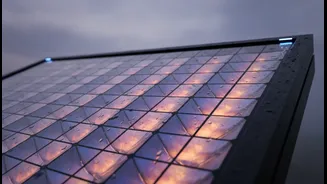
One of the most promising solutions comes from a class of materials called perovskites. Perovskite solar cells (PeSCs) are a game-changer because they are fundamentally better at capturing energy from low and diffused light than traditional silicon. Think of it as having better vision in the dark. The unique crystal structure of perovskites allows them to absorb a broader spectrum of light, making them highly efficient even under cloudy skies or indoor artificial lighting. While silicon's properties are relatively fixed, scientists can 'tune' the chemical makeup of perovskites to be optimised for the specific light conditions found on an overcast day. This could mean a significant boost in energy generation during the monsoon, making solar a more reliable year-round power source.
Generating Power from Rain Itself
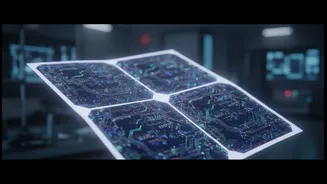
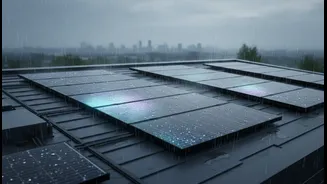
What if rain didn't just block the sun, but could actually generate electricity? This is the revolutionary concept behind hybrid solar panels. Researchers are integrating a technology known as a triboelectric nanogenerator, or TENG, into solar panels. A TENG can generate a small electrical charge from mechanical energy—in this case, the physical impact of raindrops hitting the panel's surface. Essentially, the friction from falling and rolling raindrops creates static electricity that can be harvested. Scientists have developed transparent TENG layers that can be placed over a standard photovoltaic cell, allowing the panel to harvest energy from both sunlight and rain, sometimes even at night if it's raining.
Other Promising Technologies
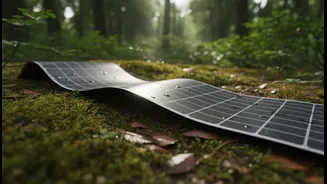
Beyond perovskites and TENGs, other innovations are also enhancing low-light performance. Heterojunction (HJT) and TOPCon (Tunnel Oxide Passivated Contact) are two advanced technologies being adopted by Indian manufacturers. These designs are more efficient than older panels at converting diffused light into energy, resulting in better performance during early mornings, evenings, and on cloudy days. Another simple but effective innovation is the bifacial panel, which can capture light from both sides. On an overcast day, these panels can absorb scattered light that reflects off the roof surface, adding a small but significant boost to the total output.
From the Lab to Indian Rooftops
While these technologies are incredibly promising, it's important to manage expectations. Most all-weather hybrid panels that generate power from rain are still in the research and development phase. Key challenges around durability, manufacturing cost, and scalability need to be solved before they become a common sight. Perovskite cells have also faced issues with long-term stability when exposed to moisture and heat, although recent breakthroughs are addressing these problems. However, more efficient low-light panels using TOPCon and HJT technology are already entering the Indian market. Manufacturers like Waaree Energies, Adani Solar, and Vikram Solar are increasingly focusing on panels designed for India's diverse and challenging weather conditions.