



The Fact That’s Breaking Brains
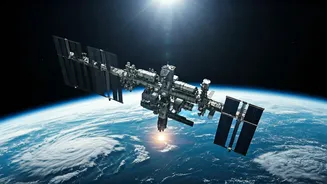
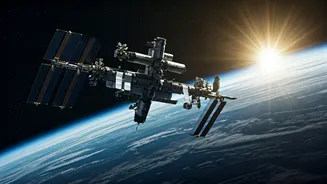
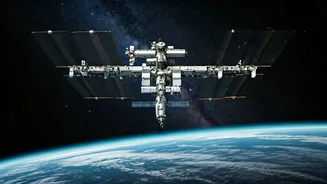
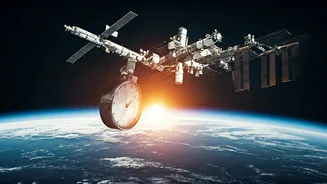
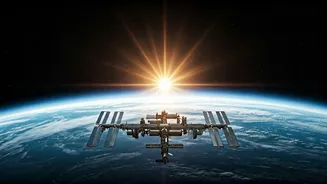
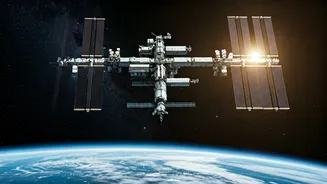
Here's the takeaway that has space enthusiasts buzzing: astronauts aboard the International Space Station (ISS) age just a tiny bit slower than people on Earth. It’s not science fiction; it’s a real, measurable phenomenon. For every six months an astronaut spends
in orbit, they return to Earth approximately 0.005 seconds younger than if they had stayed home. While you won't notice the difference, it’s a stunning confirmation of one of the most profound theories in physics.
A Consequence of Incredible Speed
The main reason for this bizarre effect is the ISS's blistering speed. The station whips around our planet at about 28,000 kilometres per hour, completing a full orbit every 90 to 93 minutes. This is where Albert Einstein's theory of special relativity comes into play. In the simplest terms, Einstein showed that space and time are interwoven into a single fabric. His theory predicts that the faster you move through space, the slower you move through time relative to a stationary observer. The effect is called time dilation. For the astronauts hurtling through orbit, their internal clocks—and the very process of aging—are ticking ever so slightly slower than yours.
Gravity Plays a Part, Too
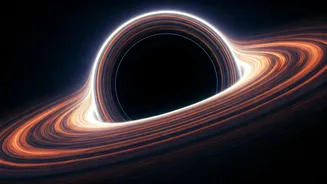
But speed is only half of the story. Einstein's other blockbuster theory, general relativity, also has a say. General relativity explains that gravity can bend spacetime. The stronger the gravitational pull, the slower time passes. This means that because the astronauts on the ISS are about 400 kilometres above the surface, they are in a slightly weaker gravitational field. This effect, known as gravitational time dilation, actually causes their clocks to tick a little faster than ours on the ground. However, the effect of their immense speed is much more powerful than the effect of their increased altitude. When you do the maths, the speed-induced slowing of time wins out, resulting in a net slowdown.
So, Is This a Fountain of Youth?
Before you start saving up for a trip to orbit to extend your life, let's put this in perspective. The amount of time saved is infinitesimally small. An astronaut would have to spend thousands of years in orbit for the time difference to add up to even a single day. The real effects of space on the body are far from youth-enhancing; astronauts have to contend with muscle atrophy and bone density loss due to the lack of gravity, which are effects that mimic the aging process. They combat this with a rigorous two-hour daily exercise routine on specially designed equipment.
Why We Love This Fact
So why is this tiny, impractical time difference so fascinating? Because it’s a real-world demonstration of a concept that sounds like it was ripped from a movie script. It makes the abstract and mind-bending ideas of relativity tangible. We don't need a spaceship traveling near the speed of light to see these principles in action; we can see them at work right above our heads. This fact isn't just trivia; it's a reminder that the universe operates on rules that are far stranger and more wonderful than our everyday experience suggests. It perfectly captures the wonder of space exploration—pushing boundaries and revealing the extraordinary nature of reality itself.