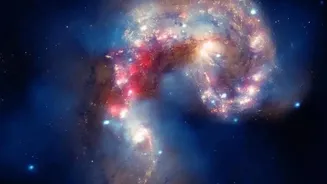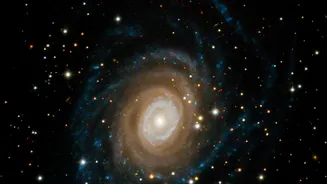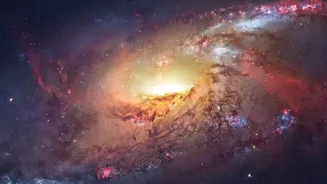




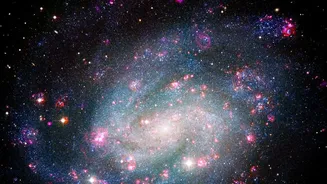
More Than Meets the Eye
Think of light as a broad spectrum of energy, like all the stations on a radio dial. The sliver our eyes can see, called visible light, is just one “station”. The full range of this energy is the electromagnetic spectrum, and it includes everything from
low-energy radio waves to incredibly high-energy gamma rays. For much of history, our understanding of the cosmos was limited to what we could see. But by building telescopes that can detect these invisible wavelengths, many of which are blocked by Earth's atmosphere, scientists have unlocked entirely new ways to view the universe. An object that seems quiet in visible light might be screaming with activity in X-rays or radio waves.
A Cosmic Case Study: Centaurus A
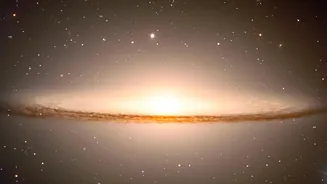
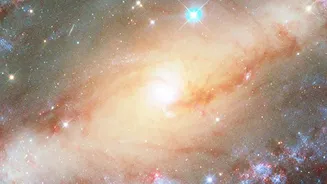
To understand how this works, let's look at a single galaxy: Centaurus A. Located about 12 million light-years away, it’s the nearest giant galaxy with an active, supermassive black hole at its core. This makes it a perfect laboratory for multi-wavelength astronomy. In a standard optical telescope, Centaurus A looks like a large, hazy elliptical galaxy sliced in half by a thick, dark lane of dust. That dust band hides the galaxy's heart from our view. But when astronomers look with different kinds of light, the galaxy tells a much more dramatic story.
Radio and Infrared: Piercing the Veil
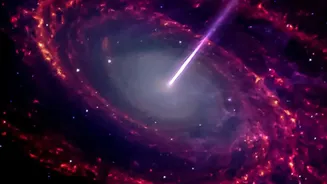
Switching to radio wavelengths reveals a truly spectacular sight. Two enormous jets of high-energy particles are seen blasting out from the galaxy's center, extending more than a million light-years into space. These jets, powered by the central black hole, are completely invisible in a normal photo. Radio waves also allow astronomers to map the cold hydrogen gas that serves as the raw fuel for future star formation.Infrared light, which we feel as heat, provides another crucial view. Because infrared can penetrate the thick dust that blocks visible light, telescopes like the Spitzer Space Telescope can peer into the galaxy's core. In the infrared, that dark dust lane from the optical image begins to glow, revealing where new stars are being born inside hidden cosmic nurseries.
X-Rays and Gamma Rays: A Violent Universe
At the high-energy end of the spectrum, things get even more intense. X-ray telescopes like Chandra show one of the jets emanating from the black hole with incredible clarity. X-rays trace extremely hot gas—millions of degrees—and material caught in the immense gravitational pull of the supermassive black hole. These views point to a history of cosmic violence, likely the result of a merger between two smaller galaxies billions of years ago.Gamma rays, the most energetic form of light, reveal the most extreme phenomena. In active galaxies like Centaurus A, gamma rays are produced by high-energy cosmic rays colliding with interstellar gas and around the black hole, giving scientists clues about the most powerful processes in the universe.
The Full Picture
By combining all these different views—radio, infrared, visible, ultraviolet, X-ray, and gamma-ray—astronomers can assemble a complete, multi-layered understanding of a galaxy. They can see the reservoir of cold gas (radio), the birth of new stars (infrared), the population of existing stars (visible), and the violent activity powered by the central black hole (X-ray and gamma-ray). What appears as a single, static object in one wavelength becomes a dynamic, evolving ecosystem when viewed across the entire spectrum. It’s like watching a movie instead of looking at a single photograph.