




The Core Foundation: Engineering & Sciences
The bedrock of any space programme is its engineering and scientific talent. While the field is expanding, the fundamental disciplines remain as crucial as ever. A bachelor's degree in fields like aerospace, mechanical, electrical, or electronics and communication
engineering provides the most common pathway. These qualifications are the traditional entry point into organisations like the Indian Space Research Organisation (ISRO) and the wave of new private companies. A deep understanding of physics, advanced mathematics, and core engineering principles is non-negotiable for most technical roles. Institutions like the Indian Institute of Space Science and Technology (IIST) in Thiruvananthapuram offer a direct pipeline into ISRO for their graduates, but top engineering colleges across the country are also fertile ground for recruitment by the burgeoning private sector.
The Digital Frontier: Software, Data, and AI
The most valuable resource coming from space today is data. Earth observation satellites generate petabytes of information, creating a massive demand for professionals who can interpret it. This has made data scientists, machine learning engineers, and Geographic Information System (GIS) analysts indispensable. Skills in programming languages like Python, C++, and software like MATLAB are now as vital to the space economy as rocket propulsion. Companies like Pixxel and SatSure are hiring experts to build algorithms that analyse satellite imagery for sectors like agriculture, climate change monitoring, and urban planning. Furthermore, ISRO and private players are increasingly using Artificial Intelligence (AI) for everything from autonomous spacecraft navigation and health monitoring to analysing mission data, making software skills a critical growth area.
Building the Hardware: Advanced Manufacturing and Robotics
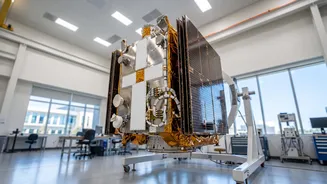
Building the machines that fly to space requires cutting-edge manufacturing skills. The industry is moving towards advanced techniques like 3D printing (additive manufacturing) for creating complex components and even entire rocket engines. Startups like Agnikul Cosmos are pioneering 3D-printed engines, creating demand for specialists in materials science and advanced manufacturing. Alongside this, robotics and automation are becoming central. Future missions will rely heavily on robotic systems for tasks ranging from spacecraft assembly on the ground to planetary exploration and in-orbit servicing. This means careers for robotics engineers, avionics technicians, and mechatronics specialists are poised for significant growth as the hardware of space exploration becomes more sophisticated and autonomous.
The Ecosystem Builders: Beyond the Launchpad
A thriving space economy needs more than just scientists and engineers. As the sector commercialises, a talent gap in non-technical domains is becoming just as critical. The rise of over 400 private space startups means there is a growing need for business development managers to secure funding and build partnerships. Space lawyers are required to navigate the complexities of international treaties, intellectual property, and launch liabilities. Marketing professionals and communication specialists are needed to tell the stories of these companies and explain their complex work to clients and the public. Even roles like 'Bid Manager' and 'Visual Designer' are appearing on the career pages of space-tech firms, showing that diverse talents are needed to build the full ecosystem.
The Human Element: Essential Soft Skills
In an industry defined by complex, high-stakes projects, technical knowledge alone is not enough. The ability to collaborate effectively in multidisciplinary teams is crucial, as engineers must work alongside scientists, software developers, and project managers. Strong analytical and problem-solving skills are paramount for troubleshooting issues where there is zero margin for error. Clear communication is also vital for coordinating tasks and conveying complex information accurately. In a sector that is constantly pushing the boundaries of what's possible, a drive for innovation and a passion for continuous learning will ultimately set successful candidates apart.