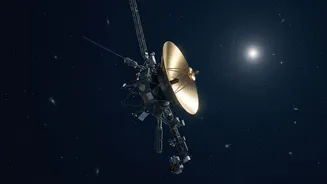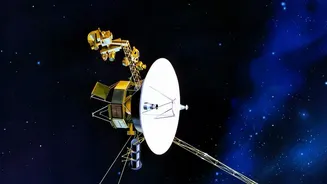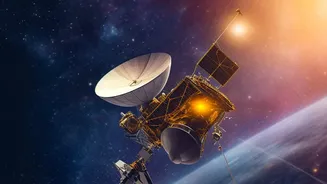




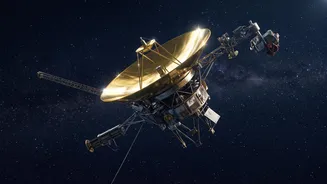
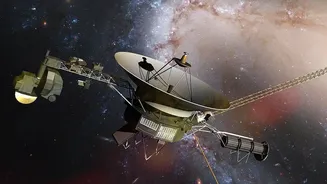
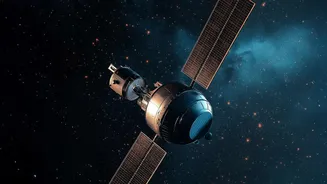
Launched when Jimmy Carter was president, NASA’s Voyager 1 is about to mark a new, mind-bending milestone. After nearly 50 years, humanity's farthest object will be one light-day from home, a testament to its incredible endurance.
A Journey Measured in Light
On November 18, 2026,
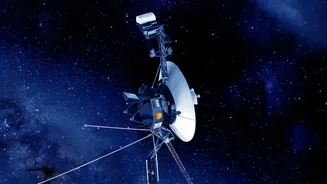
after traveling for more than 49 years, the Voyager 1 spacecraft will achieve a milestone once confined to science fiction: it will be one light-day away from Earth. This means a signal traveling at the speed of light—the fastest anything can travel—will take a full 24 hours to cover the 25.9 billion kilometers separating the probe from its creators. Every command sent by NASA will take a day to arrive, and the subsequent reply will take another day to return. This two-day communication lag underscores the immense and almost incomprehensible scale of Voyager's journey. It's a purely symbolic milestone, as nothing will physically change for the car-sized probe as it coasts silently through the void. But it serves as a powerful reminder of the persistence and ingenuity that have kept this relic of 1970s technology alive and communicating from interstellar space.
From Grand Tour to Interstellar Explorer
Voyager 1's longevity is even more remarkable considering its original mission. Launched on September 5, 1977, its primary goal was to conduct flyby studies of Jupiter and Saturn. It succeeded brilliantly, capturing the first close-up images of Jupiter's Great Red Spot, discovering active volcanoes on the moon Io, and revealing the complex structure of Saturn's rings. After its Saturn encounter in November 1980, its trajectory bent it northward, away from the plane of the planets and toward the great unknown outside our solar system. In August 2012, it made history by becoming the first human-made object to cross the heliopause—the boundary where the Sun's magnetic field and solar wind give way to the interstellar medium. What was meant to be a four-year planetary mission transformed into an interstellar odyssey that continues to this day.
The Engineering of Endurance
Keeping a nearly 50-year-old spacecraft operational is a constant battle against time and the harsh environment of space. The probe's power comes from decaying plutonium, which generates less energy each year. To conserve what remains, NASA engineers have been forced to make difficult choices, methodically shutting down instruments one by one. Today, only two of its original ten science instruments remain active, sampling the faint plasma and magnetic fields between the stars. Engineers have had to get creative, performing complex power-shuffling operations and even firing up backup thrusters that had been dormant since 1980 to keep the mission going. These efforts highlight the probe's robust, over-engineered 1970s design, which was built to withstand the intense radiation of Jupiter and has proven resilient enough for decades in deep space.
A Message in a Cosmic Bottle
Beyond its scientific data, Voyager 1's most profound legacy may be the message it carries. Affixed to its side is the Golden Record, a 12 inch, gold plated copper phonograph disc. Conceived by a committee led by astronomer Carl Sagan, it's a time capsule intended for any intelligent extraterrestrial life that might one day encounter the silent spacecraft. The record contains 116 images, a variety of natural sounds like wind and surf, greetings in 55 human languages, and 90 minutes of music from across cultures and eras, from Bach to Chuck Berry's 'Johnny B. Goode'. It even includes the brainwaves of writer Ann Druyan, recorded as she thought about Earth's history and what it feels like to be in love. It is a portrait of humanity, launched with the hope that our story might outlive us.