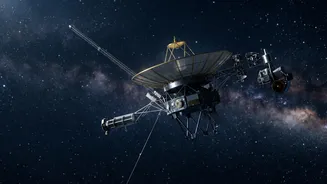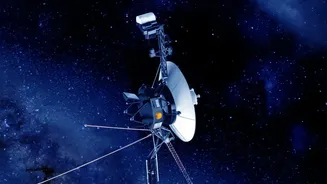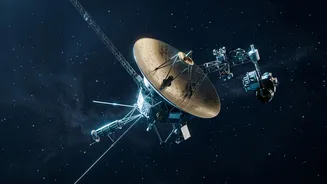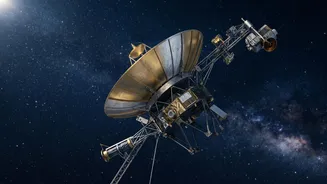






Just when you think the Voyager 1 story can't get any more astonishing, it does. After falling silent again in October 2026, humanity’s most distant object has started talking back—and this time, it seems to have fixed itself.
An Eerie Silence, Again
For nearly half a century,
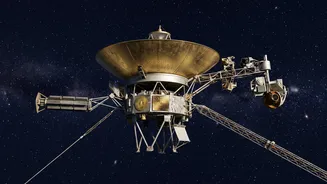
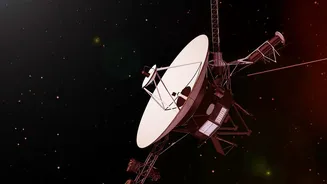
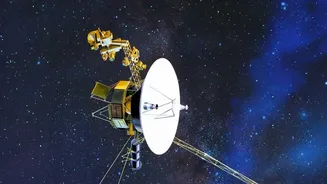
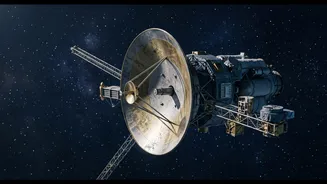
NASA’s Voyager 1 has been our steadfast emissary to the cosmos. Launched in 1977, it has journeyed farther than any human-made object, currently hurtling through interstellar space. But its incredible longevity has not been without drama. After engineers performed a heroic long-distance repair in 2024 to fix a faulty memory chip that was scrambling its data, the probe returned to sending valuable information from beyond our solar system. That made its sudden silence in mid-October 2026 all the more alarming. For 48 tense hours, during two scheduled check-ins, the Deep Space Network heard nothing. The veteran explorer, now billions of kilometers from home, had gone quiet once more.
A Ghost in the Machine
Engineers at NASA’s Jet Propulsion Laboratory (JPL) immediately began working the problem, but the distances involved are almost incomprehensible. By late 2026, Voyager 1 is so far away—nearly 26 billion kilometers—that a radio signal takes almost a full day to reach it. A command sent from Earth and its subsequent response require a two-day wait. Before the mission team could even transmit a diagnostic command, something extraordinary happened. On October 20, Voyager 1’s signal reappeared. It was clear, stable, and transmitting data. The probe had resurrected itself, without a single instruction from its creators. ‘This is the first time we've seen the spacecraft do something like this,’ said Kareem Badaruddin, Voyager mission manager at JPL, in a statement.
The Ultimate Autonomous Repair
So, what happened out there in the cold, dark void? While investigations are ongoing, the initial analysis from JPL points to one of the spacecraft's own fault-protection routines. It appears a group of active thrusters went offline for an unknown reason. This automatically triggered an onboard program that switched to a backup set of thrusters. This swap is a pre-programmed safety measure, designed decades ago to ensure the probe could keep itself stable if it detected a problem. In this case, the glitch that knocked the primary thrusters offline seems to have also caused the communications blackout. The autonomous switch to the backup system not only stabilized the spacecraft but also resolved the communication issue. It was the first time an automatic fault correction of this nature had occurred, a testament to the foresight of its original designers.
A Resilient Explorer's Next Chapter
This spontaneous recovery is another remarkable chapter in a mission defined by them. It also serves as a critical lesson for future deep_space exploration, where autonomous systems will be essential for probes venturing to destinations so far away that real_time human intervention is impossible. The event comes as Voyager 1 approaches another historic milestone: on November 18, 2026, it will be one 'light_day' from Earth, meaning light itself takes 24 hours to travel that distance. Despite its age and dwindling power supply—which loses about four watts per year—engineers believe the mission can continue sending back data from at least one instrument into the 2030s. Clever power_saving maneuvers, nicknamed the 'Big Bang,' were recently performed to extend the life of its remaining science instruments even further.