





The Tyranny of the Rocket Equation
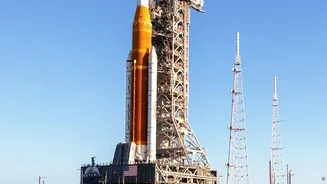
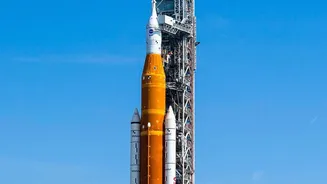
Every kilogram of payload launched into space is enormously expensive, costing thousands of dollars to escape Earth's gravity. This fundamental constraint dictates the scope of any mission. For the ambitious Artemis program, which aims to establish a permanent
human presence on the Moon and eventually send astronauts to Mars, the logistics are staggering. Water, essential for drinking, growing food, hygiene, and producing breathable oxygen, is one of the heaviest and most crucial resources. Before advanced recycling systems were developed for the International Space Station (ISS), water could account for nearly half the payload weight on resupply missions. For long-duration stays on the Moon or a multi-year trip to Mars, launching all the necessary water from Earth is simply not feasible. It would require an astronomical number of launches, making the missions prohibitively expensive and complex.
Living Off the Land in Space
NASA's solution is a concept known as In-Situ Resource Utilization, or ISRU. Put simply, ISRU is the practice of collecting, processing, and using materials found at the destination to create products and services. This approach is considered a game-changer, essential for making deep-space exploration affordable and sustainable. Instead of packing everything, future explorers will act more like pioneers, harnessing local resources. This includes mining lunar soil, or regolith, for water ice and metals, and, critically, capturing constituents from planetary atmospheres. The headline technology, reusing atmospheric water vapor, is a key component of this broader ISRU strategy. On the ISS, systems already capture moisture from astronauts' breath and sweat, recycling it into pure drinking water with over 90% efficiency. This proves the concept is sound; the next step is applying it to alien environments.
Harvesting Water from Thin Air
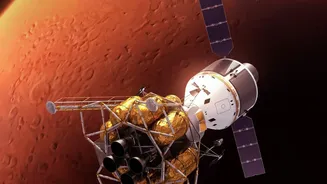
While the Moon has no significant atmosphere, Mars does. Though thin, the Martian atmosphere contains water vapor. NASA is actively developing and investigating technologies to extract this resource. One method involves rovers with systems that draw in the Martian air and cool it to condense the water vapor, similar to how dew forms on Earth. Similar technologies are already being tested by the U.S. Army in arid deserts, demonstrating the ability to pull liters of clean water directly from the air. Other advanced concepts involve using super-absorbent materials, or hygroscopic gels, to trap water molecules from the air, which can then be heated to release the water for collection. These systems could provide a steady supply of water for astronaut crews, a critical step towards self-sufficiency on another planet.
From Water to Rocket Fuel
The water harvested in-situ has applications far beyond life support. Through a process called electrolysis, water (H2O) can be split into its component elements: hydrogen and oxygen. The oxygen can be used to create breathable air for habitats, but just as importantly, liquid oxygen and liquid hydrogen are powerful rocket propellants. By manufacturing propellant on the Moon or Mars, missions can refuel their vehicles for the return journey to Earth or for further trips into the solar system. This single capability drastically reduces the mass that needs to be launched initially, as the propellant for the return trip doesn't have to be carried all the way from Earth. This is how reusing atmospheric water directly "saves payloads." It allows for lighter, less expensive launch vehicles and frees up mass for more scientific instruments, habitat modules, or other vital cargo.
The Artemis and Gateway Connection
These ISRU technologies are not just theoretical; they are integral to the Artemis program's long-term vision. The Gateway, a planned lunar-orbiting outpost, will serve as a testing ground for many of these advanced closed-loop systems, including robust water filtration and recycling. For lunar surface missions, NASA is funding the development of excavators and processors designed to extract water ice from the permanently shadowed craters at the Moon's poles. While the initial Artemis missions will still carry water from Earth, the plan is to increasingly rely on lunar resources to support a permanent base. The lessons learned and technologies proven on the Moon will then be applied to the even greater challenge of sending humans to Mars, where atmospheric water harvesting will be an essential tool for survival and exploration.