

The Martian Garden Problem
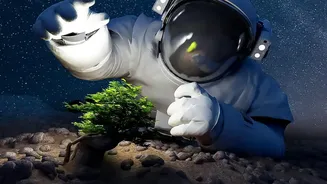
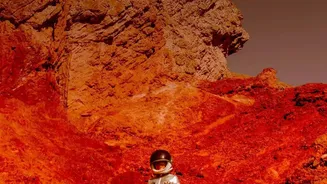
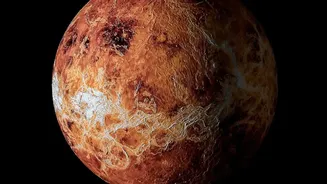
Growing plants on Mars is far more complicated than simply planting a seed in the ground. The Martian surface is a hostile environment for Earth-based life. Firstly, what people call 'soil' on Mars is actually regolith, a lifeless mix of dust and broken
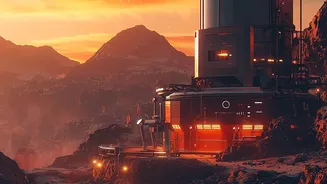
rock. This regolith lacks the essential organic matter and microbial life that Earth soil contains. Worse, it’s laced with toxic chemicals called perchlorates, which would need to be washed out before plants could grow. Beyond the soil, the planet itself presents immense hurdles. Mars receives significantly less sunlight than Earth, its thin atmosphere offers little protection from intense radiation, and extreme cold can freeze plants instantly. Any attempt at traditional farming would require a heavily protected, pressurized, and artificially lit structure, making open-field agriculture impossible.
Farming Without Earth
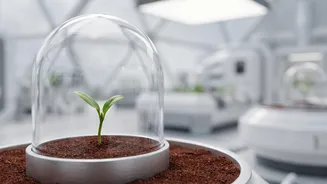
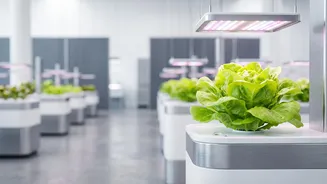
This is where soil-free farming, technically known as Controlled Environment Agriculture (CEA), comes in. The basic idea is to remove the unpredictability of soil and environment entirely. Instead of letting roots search for nutrients in the dirt, these systems deliver a precisely mixed solution of water and minerals directly to the plants. The entire process happens within a closed-loop system, where temperature, humidity, and light are all carefully managed. This approach turns agriculture from an environmental gamble into a predictable, scientific process. For a mission where every calorie and drop of water counts, this level of control is not just a benefit—it is a necessity. It’s the reason space agencies have been experimenting with these techniques for decades.
Hydroponics and Aeroponics: The Top Contenders
Two primary methods dominate the conversation around space agriculture: hydroponics and aeroponics. Hydroponics involves growing plants with their roots submerged in a nutrient-rich water solution. This technique is already used extensively on Earth for everything from lettuce to tomatoes and has been successfully tested on the International Space Station (ISS). Aeroponics takes this a step further. In an aeroponic system, plant roots are suspended in the air and periodically sprayed with a fine mist of nutrient-laden water. NASA has shown significant interest in aeroponics because it is incredibly efficient, using up to 98% less water than traditional soil farming. This efficiency is a massive advantage in a resource-scarce environment like space or a future Martian habitat.
A Perfect Match for a Hostile Planet
Soil-free systems seem almost tailor-made to solve the challenges of Martian agriculture. Because they are enclosed, they naturally shield plants from harmful radiation and the extreme Martian climate. Their closed-loop design means that nearly 100% of water can be recycled, a critical feature for a planet where liquid water is scarce. These systems also allow for vertical farming, where plants are stacked in layers. This dramatically increases the amount of food that can be grown in a small, pressurized habitat, saving valuable space and energy. By delivering nutrients directly, hydroponics and aeroponics bypass the problem of toxic Martian regolith entirely, eliminating the need for complex soil processing.
Lessons from the International Space Station
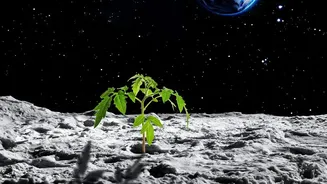
This isn't just theory; it's being actively tested in orbit. NASA's Vegetable Production System, or 'Veggie', has been onboard the ISS since 2014, successfully growing crops like lettuce, Chinese cabbage, and kale. In 2015, astronauts ate the first salad grown in space. More advanced systems like the Advanced Plant Habitat (APH) and the XROOTS experiment are testing both hydroponic and aeroponic techniques in microgravity. These experiments are proving that plants can thrive in space and are providing crucial data on everything from water delivery to light spectrums. They also offer a psychological boost for astronauts on long missions, who report that caring for the plants is a relaxing and enjoyable activity.
Hurdles That Remain
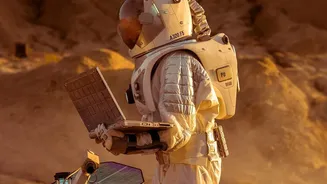
Despite the promise, significant challenges must be overcome before we can build a self-sustaining farm on Mars. The biggest issue is energy. Powering the high-intensity LED lights and climate control systems needed for a large-scale farm will require a massive and reliable power source, likely a small nuclear reactor. Another problem is securing all the necessary nutrients. While much can be recycled, some elements like nitrogen are not readily available on Mars and might need to be imported from Earth initially. Finally, the systems themselves must be incredibly robust and automated. On Mars, there is no room for crop failure or system breakdowns, meaning these farms will rely heavily on robotics and AI to monitor plant health and maintain operations without constant human intervention.