


A Constant Solar Barrage
It all begins with the Sun, which is constantly sending out a stream of charged particles—mostly electrons and protons—in every direction. This stream is known as the solar wind. Most of the time, it's a relatively steady flow, but during more intense
solar events like coronal mass ejections (CMEs), the Sun can release massive bursts of plasma into space. These particles travel millions of miles through space, and a portion of them head directly for Earth, carrying immense energy. Without a defense system, this radiation would be harmful to life and could even strip away our atmosphere over time.
Earth's Invisible Shield
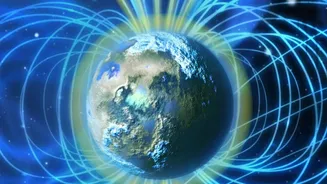
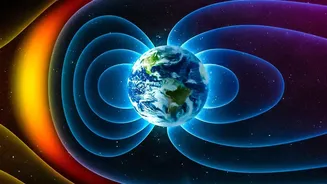
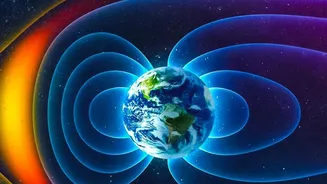
Fortunately, our planet has a powerful, invisible shield called the magnetosphere. Generated by the movement of molten iron in the Earth's outer core, this magnetic field extends far into space, creating a protective bubble around our world. As the charged particles of the solar wind arrive, most are deflected by this magnetic field, flowing around the Earth like water around a boulder in a stream. The magnetosphere compresses on the side facing the sun and stretches out into a long 'magnetotail' on the night side. This deflection is crucial for protecting our planet from the full force of solar radiation.
Funneling Particles to the Poles
While the magnetosphere deflects most solar particles, it's not impenetrable. Some particles become trapped within the field. The magnetic field lines, which curve from the South Pole to the North Pole, act like cosmic highways, guiding these trapped particles toward the polar regions. Here, in funnel-shaped areas, the magnetic field lines dip down and intersect with our upper atmosphere. This process channels the energetic particles into two large, oval-shaped zones centered on the magnetic poles, known as the auroral ovals.
The Science of the Light Show
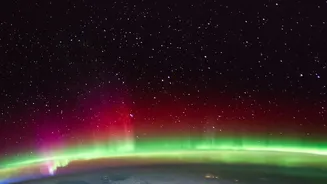
The aurora itself is what happens when these high-energy solar particles finally collide with gas atoms and molecules in Earth's upper atmosphere, primarily oxygen and nitrogen. When a fast-moving particle from the sun strikes an atmospheric gas atom, it transfers energy to that atom, exciting it. But this excited state is unstable. To return to its normal state, the atom must release that excess energy in the form of a tiny particle of light, called a photon. When billions of these collisions happen at once, the collective glow forms the shimmering, dancing curtains of light we see as the Aurora Borealis (Northern Lights) and Aurora Australis (Southern Lights).
A Dazzling Spectrum of Colors
The specific color of the aurora depends on two main factors: which gas is being struck and the altitude at which the collision occurs. The most common color, a brilliant green, is produced by collisions with oxygen molecules at altitudes of about 100 to 300 kilometers. At higher altitudes (above 300 km), where oxygen is less concentrated, collisions can produce a rarer, all-red aurora. Nitrogen is responsible for the blue and purplish-red hues. When particles hit nitrogen molecules at lower altitudes (around 100 km), they can create a blue or purple light, sometimes appearing as a pinkish fringe at the bottom edge of a green aurora during intense solar activity.