



The Universe’s Ultimate Speed Limit
Everything in our universe is bound by a fundamental rule: nothing can travel faster than the speed of light. In a vacuum, light zips along at a staggering 2,99,792 kilometres per second. To put that into perspective, a beam of light could circle the Earth
more than seven times in a single second. It’s an almost incomprehensible speed, yet when we start talking about the sheer scale of the cosmos, even this cosmic speed limit begins to seem slow. The distances between stars are so vast that even light, the fastest thing there is, takes years, decades, or even centuries to cross the gap. This delay between when the light leaves a star and when it reaches our eyes on Earth creates a fascinating phenomenon: looking at the stars is literally looking back in time.
What Exactly is a Light-Year?
Astronomers needed a better way to measure these colossal distances, so they came up with the 'light-year'. It sounds like a measure of time, but it’s actually a measure of distance. A light-year is simply the distance that light travels in one year. If you do the maths, that comes out to roughly 9.46 trillion kilometres. It’s a number so large it’s hard for our brains to process. Think of it like this: if you were to drive a car non-stop at 100 km/h, it would take you over 10 million years to cover the distance of a single light-year. When we say a star is 10 light-years away, it means the light we are seeing tonight left that star 10 years ago. The star itself could have changed, moved, or even (in very rare cases) died in the time it took for its light to reach us.
Meeting Our Cosmic Neighbours
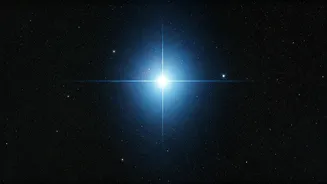
Let’s start with some of the familiar faces in our night sky. The brightest star visible from Earth, Sirius (or Vyadha), is a relatively close neighbour at about 8.6 light-years away. This means the light you see from Sirius tonight began its journey in 2015 or 2016. The children starting primary school today were just being born when that light left its star. Another prominent star, Vega (or Abhijit), is about 25 light-years away. The light from Vega that sparkles in our sky tonight started travelling around the time India was a co-host for the 1996 Cricket World Cup. Every star is a different time capsule, with its distance determining how far back in time we are peering.
A Glimpse into Indian History
This is where the headline really comes to life. Many of the stars we see with the naked eye are hundreds of light-years away. Take Polaris, our North Star, known in India as Dhruva Tara. It’s approximately 433 light-years from Earth. The faint, steady light we see from Polaris today started its cosmic voyage around the year 1591. At that time, the Mughal Empire was flourishing under Emperor Akbar. The city of Hyderabad had just been founded. While monumental shifts in history were happening across India, that specific photon of light was just beginning its 400-plus-year journey across the void of space, destined to end in your eye tonight. Similarly, many stars in the famous Saptarishi (Ursa Major) constellation are around 80-100 light-years away, their light a relic from the early 20th century, before India’s independence.
Looking Beyond Our Galaxy
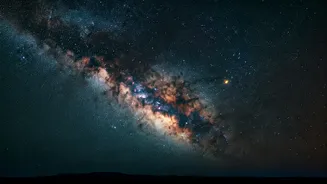
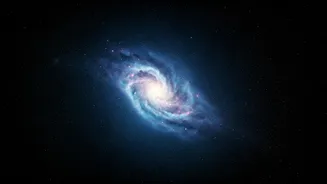
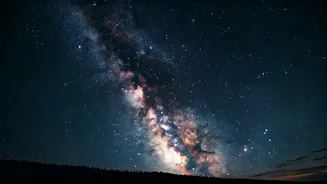
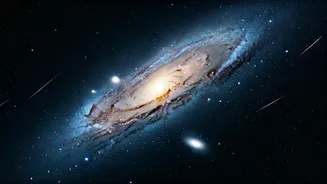
The scale becomes even more mind-boggling when we look beyond the stars in our own Milky Way galaxy. On a very clear, dark night, far from city lights, you might be able to spot a faint, fuzzy patch in the sky. This is the Andromeda Galaxy, our closest major galactic neighbour. That faint smudge is made of the combined light of a trillion stars, and that light has been travelling for 2.5 million years to reach us. When the light we see from Andromeda tonight left its source, modern humans did not exist. Our early ancestors, like Homo habilis, were just beginning to walk the Earth. Every glance at that galaxy is a look into the deep, prehistoric past.