






Meet an Ancient Sea Scorpion
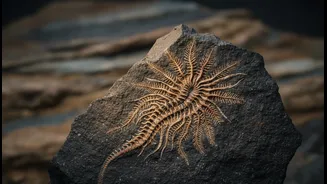
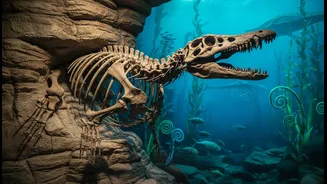
Let's travel back 450 million years to the Ordovician period. The oceans teemed with life, including formidable predators called eurypterids, or sea scorpions. These weren't true scorpions, but they were related and could be huge, with some later species
growing larger than a human. Fossils from this time are often just two-dimensional impressions left in rock, preserving the hard exoskeleton but little else. These flattened remains are the starting point, the first clues in a grand paleontological puzzle that scientists have been trying to solve since the first eurypterid fossils were identified in the early 19th century.
From Flat Fossil to 3D Puzzle
The first practical step is getting from a flat fossil to a three-dimensional skeleton. Paleontologists meticulously study the fossil, identifying each part of the creature's tough outer shell, or exoskeleton. They compare these pieces to more complete specimens and to living relatives like horseshoe crabs and spiders. Often, fossils are incomplete or damaged. Here, scientists make a critical choice: they might digitally mirror a preserved leg to reconstruct the missing one on the other side or use information from a related species to fill in the gaps. This process, blending direct evidence with informed inference, creates a complete blueprint of the animal's hard parts.
The Challenge of Soft Tissues
Rebuilding the skeleton is one thing; imagining the muscles, organs, and skin is another. Soft tissues rarely fossilize, making this the most speculative part of the reconstruction. Scientists make educated choices by studying the fossilized bones or exoskeleton for muscle attachment scars. They also use a technique called phylogenetic bracketing, where they look at the soft tissues of the organism's closest living relatives. For a sea scorpion, they might study modern horseshoe crabs to infer how its gills or digestive system might have worked. Recent incredible discoveries, like a 450-million-year-old crinoid (a starfish relative) with fossilized soft tissue, provide rare, direct windows into ancient anatomy, reducing the need for guesswork.
Choosing a Colour Palette
How do scientists know what colour an ancient creature was? The honest answer is, usually, they don't. Colour is one of the most difficult things to preserve. Therefore, the colours you see in museum displays or illustrations are often a product of artistic interpretation guided by scientific principles. Artists and scientists collaborate, making practical choices based on the animal's likely environment and lifestyle. Was it an ambush predator needing camouflage? Did it live in a vibrant, shallow sea? These considerations help them choose a plausible colour scheme, even if the exact pattern remains a mystery.
Rebuilding a Prehistoric World
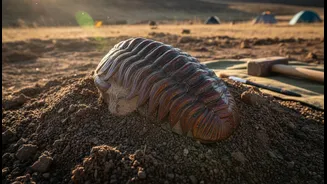
An animal doesn't exist in a vacuum. The final step is to reconstruct its world. The rock in which the fossil was found tells its own story about the environment—was it a shallow sea, a deep ocean floor, or a tidal flat? Other fossils found nearby, like trilobites or early fish, reveal what the sea scorpion might have eaten or been eaten by. Trace fossils, like preserved tracks or burrows, can even show how the animal moved. By piecing all this contextual evidence together, scientists can build a vibrant, dynamic picture of the entire ecosystem, moving from a single fossil to a complete ancient world.
Ancient India: A Fossil Hotspot
This ancient story has a powerful connection to India. The Tethyan Himalaya, particularly in regions like the Spiti Valley in Himachal Pradesh, holds a rich record of life from the Ordovician period. The Takche Formation in the Parahio Valley, for instance, contains abundant trace fossils of trilobites, like Cruziana, which are essentially the tracks and trails left by these creatures on the ancient seafloor around 450 million years ago. Geologists have also documented Ordovician-era chitinozoans—microscopic organic-walled fossils—in the Shiala Formation in Uttarakhand. These sites provide crucial clues about the shallow marine environments that covered this part of the Indian subcontinent when it was part of the supercontinent Gondwana.