





The Puzzle of a Star's Mass
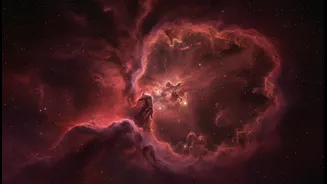
One of the biggest questions in astrophysics has long been what determines a star’s final size. We know that stars form from the gravitational collapse of enormous clouds of gas and dust. As this material spirals inward, it forms a dense, hot core known
as a protostar, which continues to pull in more matter from a surrounding 'accretion disk'. In theory, a protostar could keep growing indefinitely, becoming a behemoth. Yet, the universe is filled with stars of many different sizes, from small red dwarfs to massive blue giants. Something must happen to cut off the fuel supply and stop the star from growing. For years, scientists suspected the answer lay in jets of material fired out from the young star, but the exact mechanism remained a mystery.
Hubble's Unprecedented View
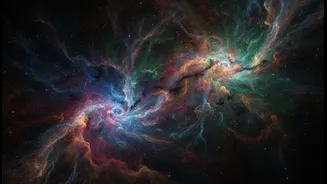
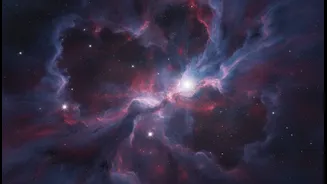
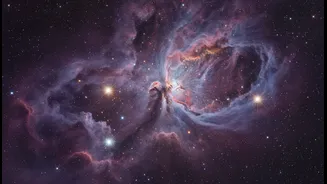
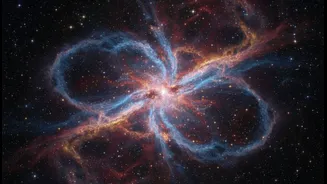
Enter the Hubble Space Telescope. By observing young stars in infrared light, which can penetrate the thick dust clouds that hide them from view, Hubble has provided an unparalleled look at these stellar nurseries. Recent observations have focused on what are known as Herbig-Haro (HH) objects. These are bright, glowing patches of gas that appear when powerful jets fired from a protostar smash into the surrounding material at incredible speeds. By studying these jets and the glowing clouds they create, astronomers can trace the violent and chaotic process of a star's birth in stunning detail, turning static pictures into a slow-motion movie that spans decades.
More Than Just Simple Jets
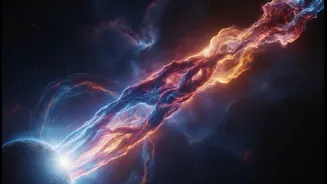
The latest findings reveal that the process is far more complex than a simple, narrow jet. One protostar, named IRAS 18162-2048, is powering the longest and fastest outflow ever seen from a young star, stretching an incredible 32 light-years across space. The material is moving at over 2.2 million miles per hour. Instead of just blowing a hole in the surrounding cloud, these powerful jets create a wide, chaotic cavity. The jets are not a steady stream but are more like a machine-gun firing 'bullets' of dense gas. This violent outflow creates shockwaves that heat the surrounding gas, causing it to glow brightly as Herbig-Haro objects.
Solving the Mass Mystery
This new level of detail helps solve the long-standing puzzle of star mass. The powerful, wide-angled outflows act like a cosmic leaf blower, clearing away the remaining gas and dust from the star's vicinity. Once this reservoir of material is pushed away, the accretion disk is starved of fuel. The young star can no longer pull in matter to grow bigger, and its final mass is effectively set. This process is crucial because it not only determines the star's future life cycle but also impacts the formation of any planets that might be coalescing in the disk. The material cleared out by the jets goes on to enrich the interstellar medium, providing the raw materials for the next generation of stars.
A Legacy of Discovery
These discoveries are a testament to Hubble's incredible longevity and power. Launched in 1990, the space telescope has revolutionized our understanding of the cosmos, from determining the age of the universe to providing visual proof of the protoplanetary disks where new worlds are born. In the case of star formation, it has captured the crucial, fleeting moments when a star stops accumulating mass and begins its long, stable life. The new findings show that star birth is not a gentle process, but an energetic, chaotic, and spectacular event that shapes the evolution of entire galaxies.