

Why Holding Poses Works
The secret to building core strength through gentle yoga lies in isometric contractions. During an isometric exercise, your muscles tense up without visibly moving, generating force in a static position. Think of a plank or wall sit. This is different
from dynamic exercises like crunches, which involve movement. When you hold a yoga pose, you are asking your core to stabilize your spine and pelvis against gravity. This consistent, controlled engagement builds deep, functional strength that supports nearly every move you make, from sitting up straight to lifting groceries. Your core is a complex system of muscles beyond just the 'six-pack' abs, including your lower back, obliques, and pelvic floor. Gentle yoga effectively trains this entire muscular 'cylinder' to work together, improving posture and reducing the risk of lower back pain.
Mountain Pose (Tadasana)
It may look like 'just standing', but Mountain Pose is a foundational posture that teaches profound body awareness and core activation. It is the blueprint for alignment in almost all other standing poses. To practice it, stand with your feet either together or hip-width apart, ensuring your weight is distributed evenly. Gently engage your thigh muscles and draw your lower belly in and up to activate your core. Roll your shoulders down and back, away from your ears, and lengthen your spine as if a string is pulling the crown of your head toward the ceiling. Let your arms rest by your sides with palms facing forward. Hold this pose for five to ten deep breaths, focusing on the subtle muscular engagement required to stand tall and steady like a mountain. This simple act of mindful standing strengthens postural muscles and enhances stability.
Cat-Cow Pose (Marjaryasana-Bitilasana)
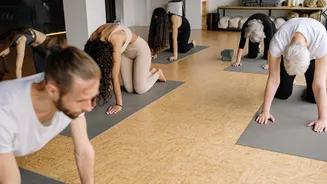
This gentle, flowing movement is excellent for improving spinal flexibility and activating the entire core. Start on your hands and knees in a tabletop position, with your wrists directly under your shoulders and your knees under your hips. As you inhale, drop your belly towards the floor, lift your chest and tailbone, and look forward into Cow Pose. As you exhale, round your spine toward the ceiling, tucking your chin to your chest and pressing the floor away, like an angry cat. This dynamic movement between two shapes not only stretches the back, chest, and abdomen but also gently strengthens the core muscles that support your spine. The rhythmic motion improves circulation, lubricates the joints of the spine, and can help relieve tension in the lower back.
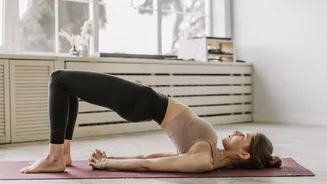
Bridge Pose (Setu Bandhasana)
Bridge Pose is a powerful yet accessible backbend that strengthens your glutes, back, and deep abdominal muscles. Lie on your back with your knees bent, feet flat on the floor hip-width apart, and close enough that you can touch your heels with your fingertips. With your arms resting by your sides, palms down, press into your feet and inhale to lift your hips off the floor. Aim to create a straight line from your shoulders to your knees. It's important to engage your glutes and hamstrings, but also keep your core tight to prevent overarching your lower back. Hold this position for 30 to 60 seconds, breathing steadily. This pose builds stability through the entire back of the body and engages the core to support the lifted position.
Bird-Dog Pose (Dandayamana Bharmanasana)
This pose is a fantastic exercise for training balance and stability, as it forces your core to work hard to prevent your torso from rotating. Begin in a tabletop position, just as you did for Cat-Cow. Engage your abdominal muscles to keep your spine neutral. On an inhale, extend your right arm straight forward and your left leg straight back, keeping both parallel to the floor. The key is to keep your hips and shoulders level, avoiding any tilting or sagging. Imagine balancing a cup of tea on your lower back. Hold for a few breaths, then exhale as you lower your arm and leg back to the starting position. Repeat on the other side, extending your left arm and right leg. This pose highlights how a strong core is essential for controlled movement.