



A Ripple in Spacetime
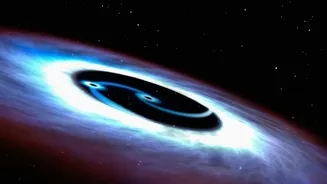
Imagine the universe as a vast, stretched-out fabric called spacetime. When massive objects like black holes collide, they create ripples in this fabric, much like a stone tossed into a pond. These ripples, known as gravitational waves, travel outward
at the speed of light. First predicted by Albert Einstein over a century ago, they carry information about their violent origins. For decades, they were purely theoretical, but since 2015, a global network of incredibly sensitive observatories has been able to detect these faint tremors. This has opened a brand new window to the cosmos, allowing us to listen to events that are invisible to traditional telescopes.
The Black Hole 'Missing Link'
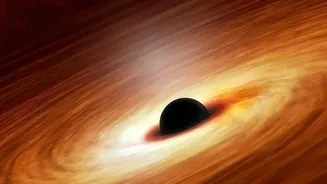
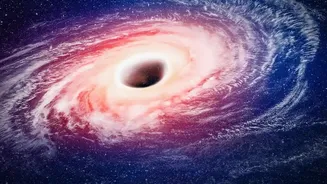
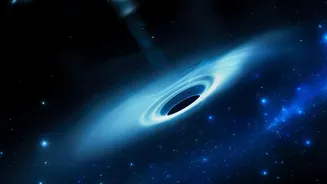
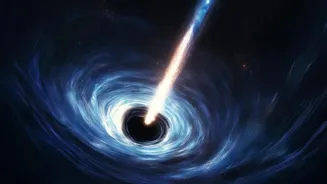
Scientists have long known about two main classes of black holes. There are stellar-mass black holes, which are typically 5 to 50 times the mass of our sun, formed from the collapse of a single massive star. At the other end of the spectrum are the supermassive black holes, behemoths weighing millions or even billions of times our sun's mass, which sit at the center of most large galaxies, including our own Milky Way. But there has always been a gap in between. Intermediate-mass black holes (IMBHs), with masses from a hundred to a hundred thousand times that of the sun, have been notoriously difficult to find. They are considered the 'missing link' because they could be the seeds from which supermassive black holes grow.
A Chirp Heard Across the Void
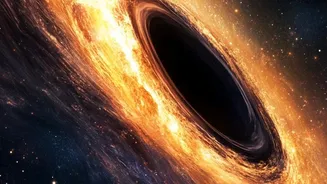
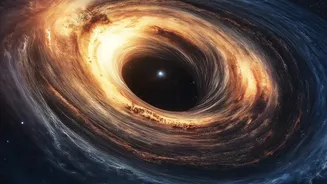
The latest breakthrough comes from the LIGO-Virgo-KAGRA (LVK) collaboration, a network of gravitational-wave detectors in the United States, Italy, and Japan. By analyzing the faint 'chirp' of a gravitational wave signal, scientists were able to reconstruct the cataclysmic event that created it. The signal's frequency and amplitude revealed the collision of two black holes that squarely fit within the intermediate-mass range. Such events are incredibly powerful, releasing more energy in a split second than all the stars in the observable universe combined, all in the form of these spacetime ripples. Finding a merger of this specific size confirms that these objects not only exist but also merge, a key prediction of theories on galaxy formation.
Filling a Cosmic Puzzle Piece
So why is this discovery so important? Finding and confirming an IMBH merger helps solve a major chicken-and-egg problem in astrophysics. How did supermassive black holes get so big? One leading theory is hierarchical merging: smaller black holes merge over billions of years, gradually building up to the giants we see today. IMBHs are the crucial stepping stone in this process. Their existence suggests that supermassive black holes could have grown from these mid-sized seeds in the early universe. This discovery provides the strongest observational evidence to date that this pathway is viable, offering a clearer picture of how the largest structures in the cosmos came to be. It helps us understand the evolution of galaxies from their infancy to the present day.